No account required, you can start reading right now. But the reader was built to do more than turn pages. A free account turns the book into a workspace you’ll come back to.
Bookmark your place
Pick up exactly where you left off, on any device.
Highlight what lands
Mark the lines that matter and find them again later.
Add your own notes
Capture your thinking right beside the text, as you read.
And it’s more than the book
Your account also unlocks your Scorecard blueprint, a personalized map of which parts of your practice to build next, and the Toolbox, where every tool, template, and worksheet referenced in these pages lives.
Free forever · No credit card · Takes about 30 seconds
Preface
Preface
Why this book exists — and who it’s for.
4 min read
On this page
A project wraps and the calendar opens up in front of you, clean and empty.
You are not resting. You are scrambling. Emails to past clients you have not spoken to in a year. Messages to leads that went cold months ago. Checking your phone more than you would admit to anyone, hoping something lands before the month turns over.
A week of that is survivable. Then the week becomes a month, and somewhere in there it stops feeling like a slow season and starts feeling like a verdict. On the decision you made. On whether you were ever cut out for this at all.
We have a name for it. Feast and famine. Consultants, coaches, advisors, freelancers, all of us, and we say it with a shrug, the way you talk about weather. That is what I want you to notice first. It is so common among people who do this work that we gave it a name, and then we stopped asking why it keeps happening.
I know that stretch. I sat in it for years, and I remember the pull to just call the whole thing off, to go find a steady paycheck and a title and let somebody else worry about where the work came from.
If you have ever felt that, you already know it is not only a business problem. It follows you home.
For fifteen years, consulting was simply what I did. Some engagements went beautifully. Others went sideways for reasons I could not name at the time. I credited the good ones to chemistry and blamed the bad ones on luck, and I kept moving, because moving was the only thing I knew to do.
At some point I stopped and looked back across all of it, the engagements that flew, the ones that stalled, and the lean stretches in between, and I saw something I had never let myself see.
None of it was as random as it had felt.
The engagements that worked did not work because the deliverable was better. The ones that fell apart did not fall apart because the work was wrong. They broke somewhere else entirely.
A client who never quite felt understood.
An expectation that was never surfaced until it was already a problem.
A referral that never came because nobody closed the loop, and a pipeline that went silent because of it.
The failures were almost never technical. They were structural. And they repeated.
Once I saw that, I could not unsee it. So I started writing it down. Not the job itself, but everything underneath and around the job. How trust got built, and how it broke. What order things had to happen in. All the parts of this job that have nothing to do with how good you are at it and everything to do with whether you make a living from it.
Over the years, those notes became a map. The map became a structure. The structure became empraxisOS™, the operating system underneath work I had been doing on instinct for more than a decade.
I never taught it to anyone. I was not hiding it. It just never occurred to me that it was worth anything to anybody but me.
What changed is that I started talking about the hard parts out loud. The isolation. The scramble. The client conversations nobody prepares you for. And every time I did, someone told me they had thought it was just them.
It is never just them. It was never just you either.
So I started walking people through the pieces, one client problem at a time, and somewhere in there helping stopped being something I chose to do and became something I could not stop doing.
That is what this book is.
Let me be clear about what it is not. It is not a get-rich-quick scheme and it is not a promise of seven figures. If you know me, you know I would not even call myself rich, at least not the way the world means it. I do not have the dream house or the fancy cars. I am not off traveling the world.
Here is what I do have. I traded a corporate nine-to-five for a practice I now run in under twenty hours a week, and what I got back was not a bigger number. It was my life.
It is being home for my kids' homeschooling and quietly becoming one of the best math teachers they know. It is coaching my son's soccer team, year after year. It is serving my church on days that are not Sunday, and giving time to my community because I actually have time to give. It is the gym in the morning and a spontaneous day date with my wife in the afternoon. It is saying yes to the friendships and the small ordinary moments that a crowded calendar cannot afford.
That is the return on this work. And it is available to you.
More than I want you to master any framework in these pages, I want you to catch the thing I caught somewhere along the way: a real love for this craft, and the nerve to bet on yourself with far less risk than I carried when I bet on me.
This was never about sticking it to the man, or saying no to the corporate nine-to-five. It's about all the yes'es: to the people you love, the things that matter, and the life you actually want.
Nothing goes up on raw land. Somebody clears it first: the brush, the stumps, whatever the last owner left behind. It is a full day of work that leaves you with an empty lot, which is exactly the point.
We have something to clear too, and it is not a tactic or a tool. It is a belief, and most of us have been building on top of it for years: that being good at the work is enough. It isn't. This book is for the consultant or coach who left the safe path to do the work they love. We were born to build and built to consult, and no one ever taught us the other half of the job. Anyone can do the work; that was never the hard part. What sets you apart is the relationship: communicating clearly, earning the client's trust, and managing their expectations from the first call to the last. That half cost me years to learn on my own. This book is me handing it over so it costs you less than it cost me.
So we clear the lot before we build anything: the tactics you have already tried, the motion you mistook for progress, and the crack running under all of it.
Begin Here
Introduction
The half of the job nobody trained you for.
6 min read
On this page
Somewhere along the line, you felt the pull to step out on your own.
For some of us it was the obvious next move, the natural progression in a field we already knew. For others it was a leap, letting go of something stable for something that wasn't. However you got here, you ended up in the same place. It does not much matter what you call yourself. Consultant, coach, freelancer, advisor, contractor, fractional executive, solopreneur. What matters is the shape of the work: clients hire you for a specific engagement with a beginning and an end, the scope is a little different every time, and what they are really buying is your judgment. You are making a living off your own expertise, with none of the scaffolding a company puts around a person.
And nobody prepared you for most of it.
The training
You were trained for the work, not the relationship
Think about how you learned your job. You either went to school or learned it yourself. You got good at it. Maybe you picked up some sales skills along the way, or learned a project management tool because a job required it.
Now think about where you learned to run a client.
Where did you learn to ask the questions that surface what someone actually needs, as opposed to what they asked for? To set an expectation before it becomes a disappointment? To say no and keep the relationship? To tell someone, out loud, that the thing they are excited about will not get them what they want?
You didn't. There was no class. There was no apprenticeship. Nobody teaches that part.
School prepares you to do the work. It does not prepare you to be the person a client hands their money, their business, and their trust to.
So we do what everyone does. We assume that being excellent at the work is enough to build a career on.
It isn't. It never was.
The drop
You already know what this feels like
A client signs on full of energy. The kickoff is good. You are both excited.
Then you do what you have always done. You put your head down and go to work. You are not ignoring them, you are earning them. Every hour goes into the thing they hired you to build, because at the end of the day that is what they paid you for.
Isn't it?
Somewhere around week three you come up for air, and something has changed. The replies come slower. The calls get shorter. The enthusiasm has cooled by a degree or two, and you cannot point to a single thing that caused it.
Nothing went wrong. The work is on track. The scope has not moved.
But while you were heads-down building, they were on the other side of the silence with no idea how it was going. And people do not sit in silence. They fill it. They start wondering whether you are still on it, whether it is going well, whether they made the right call hiring you. By the time you resurface with something excellent to show them, they have already spent three weeks quietly deciding how they feel.
So it usually is something you did.
Or more precisely, something you didn't.
That is one shape it takes. Once you know to look, there are others:
The project that should have wrapped months ago and keeps being added on to with no end in sight.
The proposal you were certain would close that simply never comes back approved.
The client who was thrilled with the work and then never called again.
The realization that you are working more hours for less money than you did last year.
None of those are work problems. Every one of them is a relationship problem, and they trace back to the same root.
You have no repeatable way of working.
Every client gets handled a little differently from the last. Every project is improvised from scratch, run on instinct and memory, assembled fresh depending on how much of you was available that week. That works, right up until it doesn't, and when it fails it never fails where you were looking.
The purpose
What this book is for
Here is what it comes down to, and it is the reason Born to Build, Built 2 Consult exists.
We were born to build, and built to consult. We left the safe path to do work we love and are genuinely good at. Anyone can do the work; that was never the hard part.
What sets you apart is the relationship. Communicating clearly. Gaining the clients trust. Managing expectations from the first call to the last. That is the half that quietly decides whether a client stays or goes, whether they refer you or forget you.
It is also the half that cost me years to learn, the expensive way, one lost engagement at a time. This book is me handing it over so it costs you less than it cost me.
Underneath it is a system I spent twelve years building and three more refining, for running the relationship as deliberately as you already run the work. It is called empraxisOS. You will not build all of it at once, and you should not try. This book gives it a name, a shape, and an order, so you can find the parts you have been running on instinct and start running them on purpose.
The payoff
What changes when you build it
That can sound abstract, so let me be specific about what actually changes.
You stop starting from zero. The engagement that ends leaves something behind: proof you can point to, a client who comes back, a name passed to someone else. Work stops arriving by luck, and the quiet stretch after a project stops being quiet.
You get more from the clients you already have. The best client you will ever win is usually the one already sitting in front of you. Most of us hand them back to the market the day the project ends, and then go looking for a stranger to replace them.
You charge for value instead of hours. When you are clearly differentiated there is nobody to be compared against, and price stops being a race to the bottom. You anchor the fee to the cost of the client's problem rather than the time on your calendar.
That is what changes in the business. Here is what changes in you.
You stop taking it personally. When something goes wrong you will be able to point at where. Not at yourself. The difference between "that engagement broke at the start, before any work began" and "maybe I am not cut out for this" is the difference between a problem you can fix and a verdict you carry around.
You lead the engagement instead of following it. Somebody has to direct the work, decide what happens when, and say plainly when something is out of bounds. If it is not you, it falls to the client, and they never wanted that job. It is the reason they hired you.
You can afford to say no. When your terms are decided before the pressure arrives and your pipeline is not empty, the wrong-fit client stops being a financial emergency. Saying no is not a personality trait. It is what becomes available to you when you are not desperate.
And you build it once. You set it up, then refine it, instead of reinventing your practice for every client, every month, forever. Each turn takes less push than the last.
Here is the part most consultants do not believe until they watch it happen. The premium, white-glove experience your best clients rave about has almost nothing to do with how many hours you poured into them. It is a small set of specific things a person needs to feel at each step of the work, and every one of them can be designed into the process itself. Build them once and every client feels like the only one you have, while the work asks less of you over time.
The VIP feeling is not expensive. It is engineered.
And none of this is really about the money. The money matters because of what it makes room for.
Think back to why you went out on your own. The freedom. The flexibility. Building something that was actually yours. Somewhere in the grind most of us lose sight of that, and the practice we built to buy our lives back ends up costing us the very thing we bought it for.
The system is not the goal. The life it makes room for is.
THE WORKBENCH
Your toolbox and your blueprint, in one place.
Everything you need to put this book to work lives in one place we call the Workbench, inside Built 2 Consult. Every tool, template, and worksheet referenced in these pages is there. So is your customized blueprint: the map from your empraxisOS Scorecard that shows you exactly which parts of your practice to build next. As you read, you will be pointed to the specific resource for each idea, so you are never left wondering how to actually do it.
So before we build anything, we have to name the thing that has quietly been working against you this whole time. It starts with a single word you were taught to chase.
You don't have a growth problem. You have a scalability problem — and alignment is the fix.
Chapter 1 of 15· 10 min read
On this page
Most of us were sold growth. Work harder, land more clients, add more services, put in more hours, and eventually the practice takes off. And growth, in that sense, is almost always available to you. You can force it. You can hustle for it. Pour enough energy in and something will move.
But the thing you actually want isn’t more. It’s something that can hold more. A practice that can carry a heavier load without you buckling under it. That isn’t growth. It’s scalability. And the two are not the same. The real challenge was never getting growth; it’s building something that can hold it. That is what this book is about.
Before we go further, a word on who I am, since we’re about to spend a book together. I spent fifteen years in this work, first as an agency owner with a team, then as an independent consultant and advisor, on both sides of the table: the one hiring the help and the one hired to give it. Everything in these pages came out of that. Not theory I read somewhere, but a system I built to make sense of the work I was already doing, and to stop making the same expensive mistakes. I call it empraxisOS, and it is the spine of this whole book.
As for who I’m talking to: if you’re still deciding whether to step out on your own, keep reading, and take this as an honest look at the terrain ahead. But mostly, I’m talking to the consultant, coach, or freelancer who is already in it: the one carrying a practice right now that’s costing more than it gives back. If that’s you, you already know this struggle far too well. You don’t need me to convince you it’s real. You need to know it has a cause, and a way out.
The chase
When every path looks possible but none feel sustainable
There’s no shortage of ways to chase growth. You reposition. You rebrand. You rebuild the website. You rewrite the offer page. You raise your rates, then quietly lower them again. You try a new niche, a new funnel, a new outreach channel, a new tool. You hire the help, fire the help, join the mastermind, buy the course, book the coach. You re-anything that might finally move the needle.
And still, it feels like a grind.
Here’s the uncomfortable part: none of those moves are wrong. That’s exactly the problem. There are endless strategies you could try, and most of them work for somebody. But nearly all of them demand an unsustainable amount of energy, time, and attention, and none of them touch the thing underneath. You can chase tactics forever and still feel stuck, because disconnected effort doesn’t scale.
Even when you win, you’re already behind: scrambling to build the next proposal, patch the next process, clean up the next mess. That isn’t momentum. It’s a treadmill. You’re running hard and the scenery never changes. That’s the hidden cost of fragmentation, and it’s the disconnect too few of us are willing to confront.
This is the hidden disconnect. Not a shortage of effort, or talent, or good ideas, but a lack of connection between the parts of your practice, so that each piece pulls in a slightly different direction and none of it compounds. It stays hidden because every piece, looked at on its own, seems fine. The website is good. The offer is reasonable. The work is strong. The problem lives in the space between them, which is exactly why it is so hard to see, and so easy to blame on something else.
Now, you might be bracing for me to hand you one more thing to try. I’m not. You’ve tried enough things, and the problem was never that you needed another one. What this book offers isn’t a tactic to bolt on or a trend to chase; it’s the structure underneath that makes the work you already do pull in the same direction. But before any structure can help you, we have to be honest about what’s actually broken.
The motion
The motion trap
Most independents are in constant motion. Producing, posting, pitching, delivering, following up. There’s activity on every front. But motion isn’t progress, and it doesn’t always lead anywhere. It’s entirely possible to be productive and still be unprofitable. You can be busy and still not be getting better.
I know that tension because I lived in it for years. And I’m not describing it as an outsider looking in; I’m describing it because you’ve probably felt it yourself. That underlying hum that says, despite all the doing and building and launching and managing, something still feels off. You’ve got activity. You’ve got ambition. Maybe you’ve even got results on paper. But scaling doesn’t feel like freedom. It feels like friction.
The season
When growth feels meaningless
“Meaningless! Meaningless!” says the Teacher. “Utterly meaningless! Everything is meaningless.”
Ecclesiastes 1:2 (NIV)
Those are the words of Solomon, by most accounts the wisest and wealthiest man who ever lived. A man who had built everything, owned everything, seen everything. And still, after all of it, he looked around and asked: what do people really gain from all their labor under the sun?
I can’t pretend to understand the depth of Solomon’s wisdom. But I can tell you I’ve felt that ache. I did everything the world told me to do. I worked harder. I adopted more tools. I chased every trend. I built pieces that never connected to anything and launched work that looked good and went nowhere. And it nearly cost me everything. It strained my marriage. It drained my health. It shook my confidence in the very work I was good at. I was busy, I was ambitious, I even had results on paper, and I still lay awake wondering whether any of it actually mattered.
And underneath all of it was the doubt. Whether I was cut out for this. Whether I had made a mistake. So many times I was ready to throw in the towel.
I don’t share that to be dramatic. I share it because I know I’m not the only one. I’ve since watched too many business owners trapped inside the very thing they built. Too many consultants chasing one more client. Too many coaches and freelancers burned out from trying to prove their worth inside broken systems. We get stuck reaching for the next shiny thing: the next tool, the next tactic, the next win, all in the hope that this one will finally be the breakthrough.
The diagnosis
The real problem isn’t growth, it’s scalability
That season taught me something I’ve believed ever since. Most of us don’t have a growth problem. We have a scalability problem.
Growth, in many ways, is simple. Pour in more effort, spend more hours, take on more clients, buy more tools, and eventually something moves. Growth can be forced, hustled, fought for. Scalability is a different beast entirely. Scalability means you can grow without the wheels falling off. It means more impact without more exhaustion. It means your practice doesn’t depend on relentless effort every single day just to stay upright. And here’s the part nobody says out loud: you can be growing in a way that breaks the business instead of building it. Most of the burned-out consultants I meet aren’t failing. They’re growing, badly.
The word
What alignment really means
So if the problem isn’t effort, or talent, or even strategy, what is it? For years I assumed the answer was a sharper strategy or a harder push. It wasn’t. The thing that was missing had a name I’d badly underestimated: alignment.
I know that word carries baggage. It gets tossed around in meetings as a feel-good buzzword, the kind of thing that belongs on a motivational poster, and it’s easy to dismiss. So let me be clear about what I don’t mean.
Alignment is not a corporate cliché, a hollow phrase to nod along to in a strategy session.
It is not perfectionism. It doesn’t mean everything is controlled, systematized, and error-free.
And it is not agreement. It doesn’t mean every decision feels good or that you never change your mind.
Alignment is coherence. It’s the structural condition where every part of your practice, your positioning, your offer, the way you attract clients, the way you run an engagement, the way you close it out, is moving in the same direction, toward the same outcome, with less friction and more flow. It’s where purpose meets structure. It’s the mechanism that turns potential into scalability. Without it, even the best ideas, tools, and instincts struggle to produce anything that lasts.
Alignment doesn’t add more to your practice. It reduces the drag. It reclaims the energy you were wasting on constant reinvention. And it turns a series of disconnected efforts into a single system that moves with purpose.
There is an old principle underneath all of this, and it reframes the whole idea of effort. The Pareto principle, the 80/20 rule, observes that roughly 80 percent of your results come from about 20 percent of what you do. Most consultants respond to that by trying to do more of everything, hoping the good 20 percent comes along for the ride. Alignment does the opposite. It is less about what you add and far more about what you remove. The leverage is not in what you do; it is in what you refuse to do, the things you have the discipline to say no to.
Remember how this chapter opened. Growth demands more: more effort, more hours, more input. And the list of more a consultant could chase is endless, another platform, another tactic, another tool, another funnel. I am not saying those things are wrong. I am saying that, in my experience, they do not move the needle nearly as much as the work I am about to walk you through. My goal for this entire book is to show you how to do more with less: to take the 20 percent that actually produces and disperse it deliberately through every stage of the flywheel, so that a small amount of the right effort creates the maximum result. That is what an aligned practice really is. Not more work. The right work, and far less of the wrong.
The five
What alignment makes possible
Alignment isn’t abstract; it delivers. When the parts of your practice work together as one, five advantages start to emerge:
Efficiency. Work moves with less waste and fewer bottlenecks. You stop reinventing your process for every client, stop duplicating effort, and stop losing energy in the gaps between tasks.
Effectiveness. Effort produces results. You’re not just working; you’re working on the right things, in the right order, so that what you do actually moves the engagement forward.
Visibility. You can finally see. An aligned practice gives you clear signals instead of noise: you know what’s working, what isn’t, and where to adjust, while there’s still time to do it.
Accountability. Every part of the system has a clear job. So when something breaks, you know exactly where to look, instead of blaming yourself, the client, or bad luck.
Adaptability. You can change one part, raise your rates, shift your niche, retire an offer, without the whole thing unraveling. A coherent practice absorbs change instead of shattering under it.
These outcomes are structural. They emerge from alignment, and they cannot be manufactured by tactics alone.
The wheel
A better mental model: alignment as the flywheel
Here’s the picture I want you to hold onto for the rest of this book. If growth is a burst of energy and scalability is how you sustain it, then alignment is what makes that energy usable. And the clearest way I know to explain it is a flywheel.
A flywheel is a heavy wheel that takes real effort to get moving. The first few turns are hard. But once it’s spinning, consistently and in rhythm, something powerful happens. The effort compounds. Friction drops. The wheel begins to carry its own weight. That’s not just efficiency; that’s momentum.
Jim Collins described this better than anyone in Good to Great:
“There was no single defining action, no grand program, no one killer innovation… Good to great comes about by a cumulative process, step by step, action by action, decision by decision, turn by turn of the flywheel, that adds up to sustained and spectacular results.”
Jim Collins, Good to Great
When his team asked what the one big push was that made the flywheel suddenly spin so fast, the answer was simple: it wasn’t one push. It was all of them added together. And then the shift arrives:
“Momentum kicks in your favor, hurling the flywheel forward. Its own heavy weight working for you. You’re pushing no harder than during the first rotation, but the flywheel goes faster and faster. Each turn builds upon the work done earlier, compounding your investment of effort.”
Jim Collins, Good to Great
That is what a coherent practice feels like from the inside. But there’s a catch. A flywheel only spins cleanly when it’s built right. If the parts are uneven or out of sync, it wobbles. It stalls. It drains more energy than it creates. That’s where most practices are stuck: not short on effort, short on cohesion. The positioning pulls one way, the offer says something slightly different, the delivery is improvised, the follow-through never happens, and so the wheel never gets to speed.
The good news is that a consulting practice has a natural shape: a specific set of parts that, once they’re aligned, spin cleanly and feed one another. That shape is the empraxisOS Flywheel. The rest of this book is about building it, one part at a time.
Here is what building it will give you. A practice where you price on the value you create instead of the going rate. Where your income is no longer capped by the hours in your day. Where better clients arrive already trusting you, stay longer, and send others your way. And where the whole thing runs on something you build once and refine, instead of rebuilding from scratch every month. That is not a promise of less work. It is a promise of work that finally adds up.
Every building starts as an idea in somebody's head. The blueprint is where it stops being a picture and becomes a set of instructions: the same plans the framer, the electrician, and the inspector all work from, so what gets built matches what was imagined.
On a real build those are different people. In your practice they are all you. You are selling on Monday and diagnosing on Tuesday, running a kickoff on Wednesday, renegotiating a scope change on Thursday, and closing an engagement out on Friday. Not one of those is the thing you trained for, and all of them are the job you were actually hired to do. Every one asks for a different set of skills and a different version of you, and the hat changes whether or not you notice it changing. What almost nobody has is something that tells them which hat they are on and what that job actually requires, so we default to the one that fits best, the skill we were hired for, and let the rest get handled however it happens to get handled.
There is a reason for that, and it is not laziness. Most of us have never watched anyone do this well. I had been at it for years before I saw another consultant run a client and a project with a level of skill I did not know was available, and it changed what I thought this work even was. Until you see it, you build from your own assumptions, because they are the only plans you have.
So here are the plans. Not a philosophy and not a pep talk, but the structure underneath the work: how trust gets built, how expectations get managed, and how communication gets designed on purpose instead of hoped for.
02
The Map
How to Read the empraxisOS™ Flywheel
Your visual guide to the framework — what you're looking at, in about two minutes. Bookmark it.
Chapter 2 of 15· 8 min read
On this page
In the last chapter, I promised you a map. This is it.
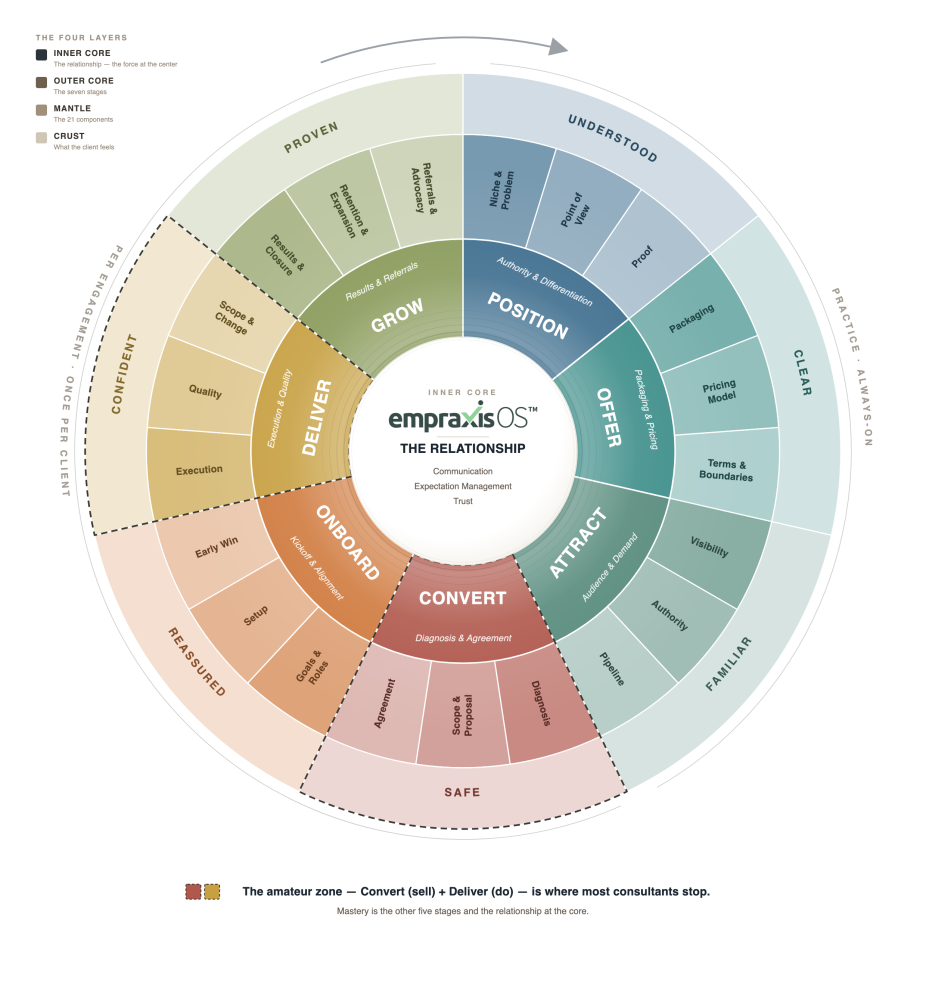
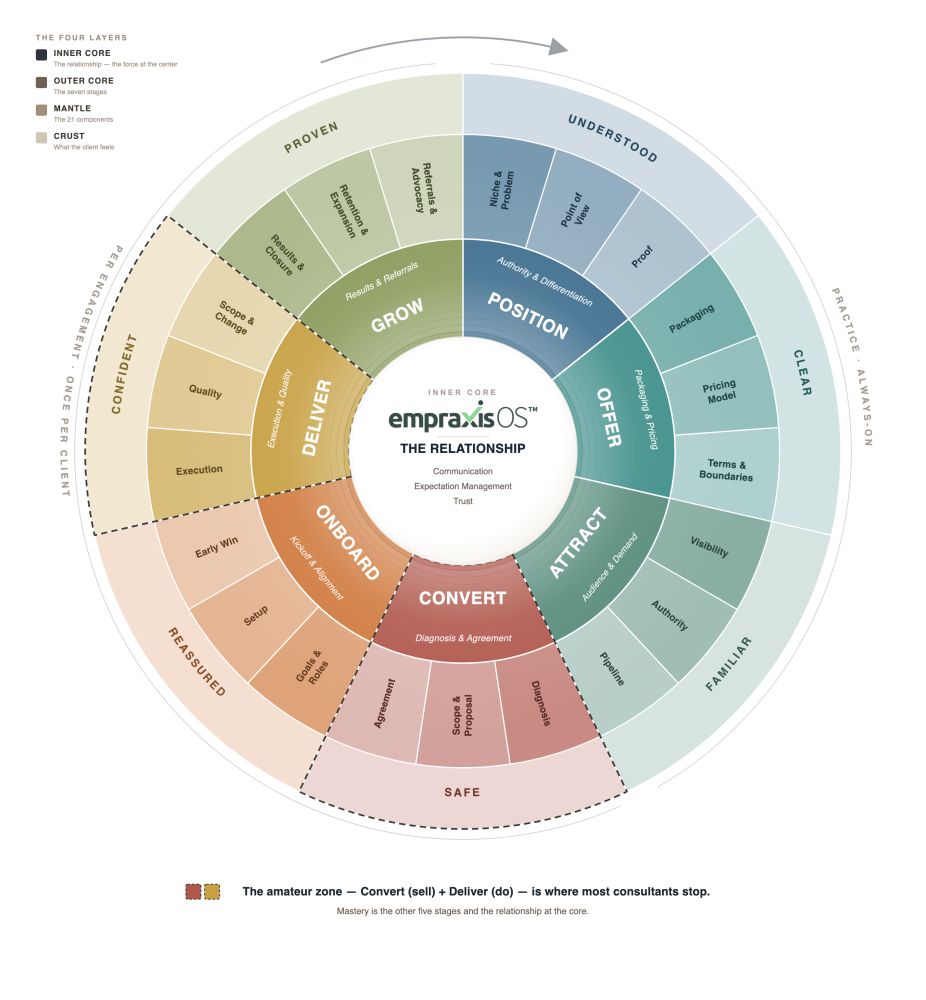
The empraxisOS™ Flywheel
Before you look too closely, let me say the thing you are probably already thinking. That is a lot of parts. You came here because your practice is taking more than it gives back, and the last thing you need is a diagram with twenty-one boxes on it telling you about twenty-one more things to do.
So here is what I want you to know before we go one step further.
You are already doing all of this.
Every stage on that wheel is something you already run. You already tell people what you do. You already put a price on work. You already have conversations that turn into projects, and you start them, and you finish them. Nobody operates a practice without doing these things.
What you are looking at is not a list of new work. It is a name for work you have been doing on instinct, and instinct is exactly what fails you on a week when you are tired.
The shape
Why it's a wheel and not a funnel
Most consulting advice is built around a funnel. Something goes in the top, a client comes out the bottom, and then the whole thing empties and you start over. That is the model most of us are running, consciously or not. Every engagement begins from the same standing stop. Every pipeline takes the same effort to refill.
A flywheel runs on different physics. It does not empty at the bottom; it feeds itself at the top. An engagement done well throws off proof, referrals, and relationships that reduce the cost of getting the next one. Each full turn generates momentum for the next. The work isn't a line that ends at the sale. It's a loop. And loops, over time, compound.
The work isn't a line that ends at the sale. It's a loop. And loops, over time, compound.
Origins
Why it's shaped this way
The shape did not come from consulting. It came from nature.
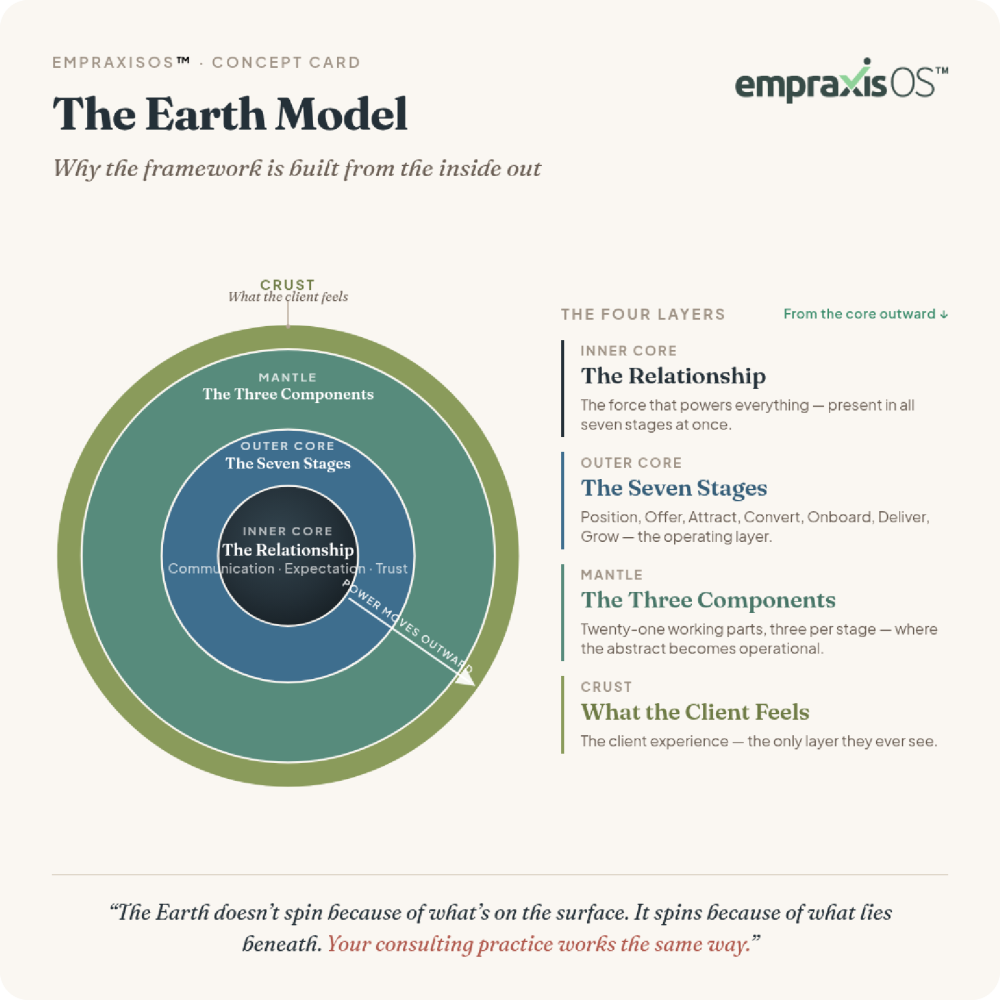
The Earth does not spin because of what is on the surface. It spins because of what lies beneath. Under the crust is a mantle where pressure builds and things move. Under that, an outer core generating the fields that make the whole thing function. And at the center, an inner core that is invisible, unreachable, and irreplaceable. Remove it and nothing turns.
Your practice works the same way. The client only ever sees the surface: the result, and what it felt like to work with you. Everything that produces that surface is underneath.
That is why each layer carries the name of its geological counterpart. Not as a metaphor. As a structural description.
The four layers mirror the Earth's structure
Structure
Read it from the center out
The wheel has four layers, and each one depends on the layers inside it. We read it from the center out, because that is the direction power actually moves.
Read the wheel from the center out, four layers around a core
Inner Core · The relationship
The center is not a stage. It has no start date and no completion checkbox. It is communication, expectation management, and trust, and none of the three belong to any single stage. They run underneath all of them at once, from the moment a client first considers hiring you until long after the engagement closes.
Almost nobody builds this on purpose. We assume it will take care of itself, and more often it erodes quietly, in ways that do not announce themselves until a client is already gone.
Outer Core · The seven stages
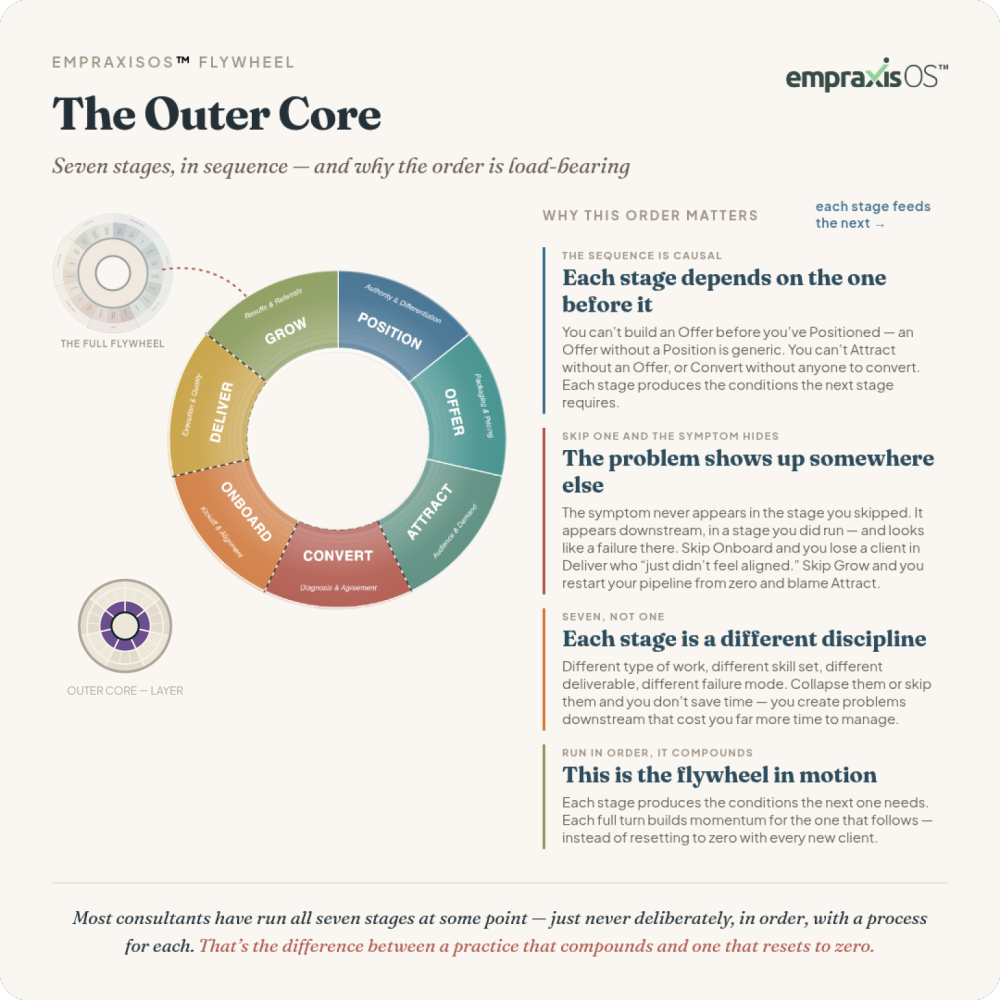
The next layer is the work itself. Seven stages, in a specific order, each doing a different job.
Position. Authority and differentiation: who you're for and what you stand for.
Offer. The work, packaged into something a client can say yes to.
Attract. Bringing the right people into your orbit, consistently.
Convert. Turning interest into a signed, aligned engagement.
Onboard. Starting the work so it's set up to succeed.
Deliver. Doing the work in a way the client can feel.
Grow. Turning finished work into renewals and referrals.
This is the operating layer, not the craft layer. Your expertise lives somewhere else, in the work you actually do for clients. These seven determine whether that expertise reaches the right people, at the right price, in a way that lasts.
Skip one and it does not stay skipped. The damage shows up later, in a different stage, looking like a different problem.
Mantle · The three components
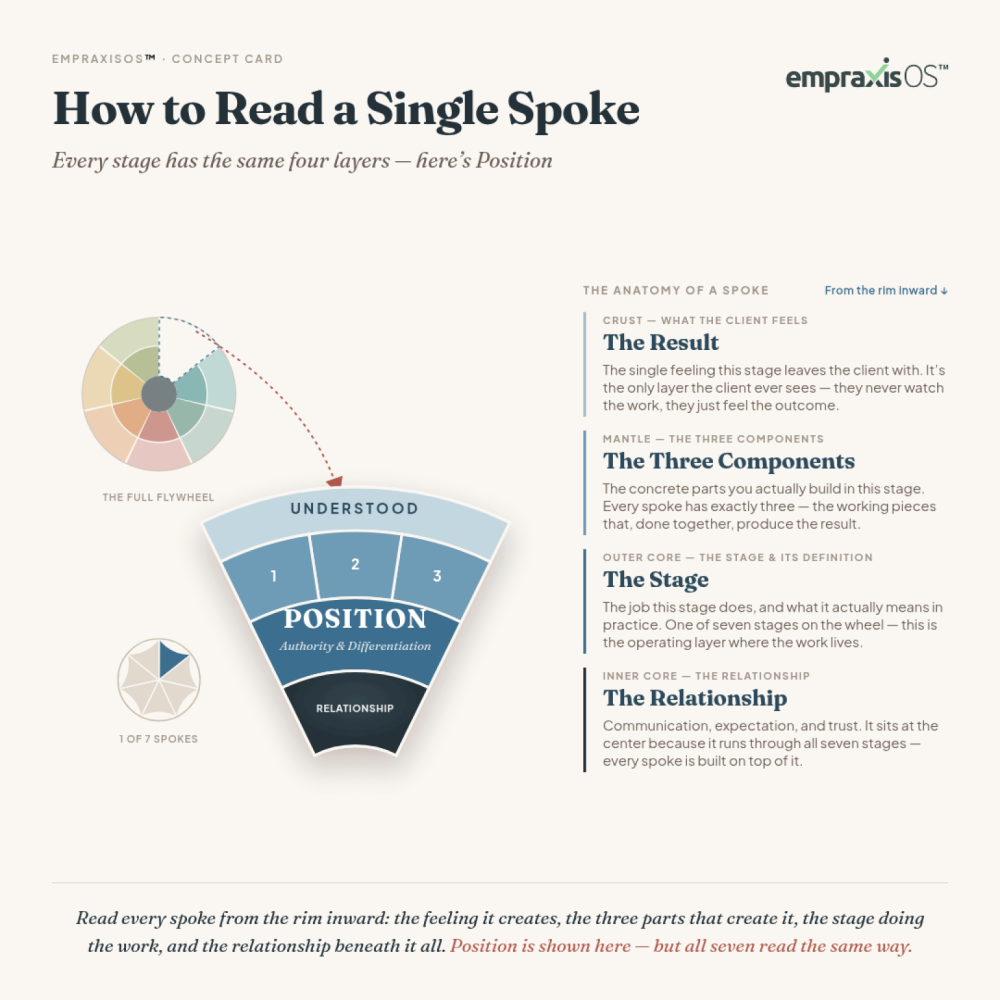
Each of the seven stages breaks into three concrete parts. This is where the system becomes something you can actually do on Monday.
"Get better at positioning" is a direction, not a task. Broken into Niche & Problem, Point of View, and Proof, it becomes three separate disciplines you can build one at a time. Twenty-one components in total, and the Mantle is where most of this book lives.
A stage with two of its three components running still looks finished from the outside. That is what makes gaps here so hard to spot.
Crust · What the client feels
The outermost layer isn't about you. It bears repeating: the outermost layer isn't about you. It is what happens on the client's side when a stage is done right. One word per stage, in order:
Stage
What the client feels
Position
Understood
Offer
Clear
Attract
Familiar
Convert
Safe
Onboard
Reassured
Deliver
Confident
Grow
Proven
Look at the first one, because it is the easiest to get backward.
You build your Position. It is your niche, your point of view, your proof. So it is natural to read that first row as the client understanding you.
It isn't. The word is Understood, and it belongs to them. It means a client reads what you wrote and feels like you were describing their situation. Their problem. In their words. It is the moment someone thinks this person is talking about me.
That distinction is small enough to miss and large enough to decide the outcome. A position that is accurate about you and says nothing about them is a position nobody responds to. Every word in that table works the same way.
These words are not aspirational. They are diagnostic. If you ran Position and your client does not feel understood, the stage did not work, no matter how clear your niche looks on paper.
The Crust is the only layer a client ever sees. Everything beneath it exists to produce it.
The pattern
The amateur zone
Two of the seven get the lion's share of attention in almost every practice: Convert and Deliver. Sell and do. The engagement begins with one and ends with the other, so they feel like the whole job.
Convert and Deliver together are the amateur zone. Not as an insult, but as a pattern. It is simply where talent without a system always lands. You do the work well. You close the deals you get in front of. And the stages that create those deals, multiply them, and make the next one easier are running at a fraction of their potential, or not running at all.
Momentum
How the wheel spins
Follow the loop. Grow, the last stage, does not end the cycle. It feeds the next one.
That is what makes this a wheel: nothing exits at the bottom. Every engagement, closed with intention, becomes force for the turn that follows. The difference between a practice that grows and one that flatlines usually isn't talent. It's whether the system captures what each engagement produces and feeds it forward.
The difference between a practice that grows and one that flatlines usually isn't talent. It's whether the system captures what each engagement produces and feeds it forward.
That's the map. From here we go layer by layer, starting at the very center, with the one layer most of us never build on purpose and the one that holds everything else together.
THE WORKBENCH
See the flywheel in motion.
The flywheel is far easier to understand when you can see it. We built an interactive version where you can explore all four layers, every stage, and how the pieces fit together and feed one another. Keep it open beside you as you work through the rest of this book, and return to it any time you need to break a piece down.
The Inner Core: Why the Relationship Is the Foundation of Everything
The thing most consultants never deliberately build — the relationship at the center of every engagement.
Chapter 3 of 15· 13 min read
On this page
The scar
The project that went perfectly until it didn't
Five years into my consulting practice I was hired to redesign and replatform an ecommerce site. I was good at that work. I still am. I buried myself in it, and everything I produced I was proud of, and the client said so out loud more than once.
Then, partway in, another group joined the project. Not an outside vendor: another department inside the client's own organization, key executives and directors among them. People who should have been in the room from the very first conversation and, for reasons nobody ever explained to me, weren't.
They came with concerns nobody had raised before. Not unreasonable ones. Just new. And we were already too far along for new. I said we could work them in, because that is what you say, and I went back to my desk and tried to make it true.
The next meeting brought more. So did the one after that. Every time I thought we were closing in on the shape of the thing, someone raised something that had never been on the table, and the shape moved again. I stopped building and started answering. I sat in the hot seat in every single meeting, and in none of them did I say the thing I was actually thinking, which was that this is not what we agreed to and we cannot keep doing this.
I told myself that staying quiet was professionalism.
The project never finished. I was told they were going in a different direction.
I went over it for a long time afterward, looking for the flaw in the work, because the work was the only thing I knew how to examine. I never found one. There wasn't one.
Everything that actually went wrong happened in the space between me and that client. In the expectations nobody wrote down. In the conversations I decided could wait. In the trust that was never built deep enough to survive a hard week.
That space has a name, and this chapter is about it.
The reason
Why we start here
By now you've seen the empraxisOS Flywheel laid out in full. You know it has four layers, Inner Core, Outer Core, Mantle, and Crust, and you know the sequence runs from the center out. Before we get into stages and components, we need to spend real time on the center.
Not because it's the most exciting part. It isn't. It's the quietest part: the piece no client will ever expect on their invoice, the piece that shows up nowhere in a deliverable, and the piece that, when it breaks, you almost never see coming until a client is already gone.
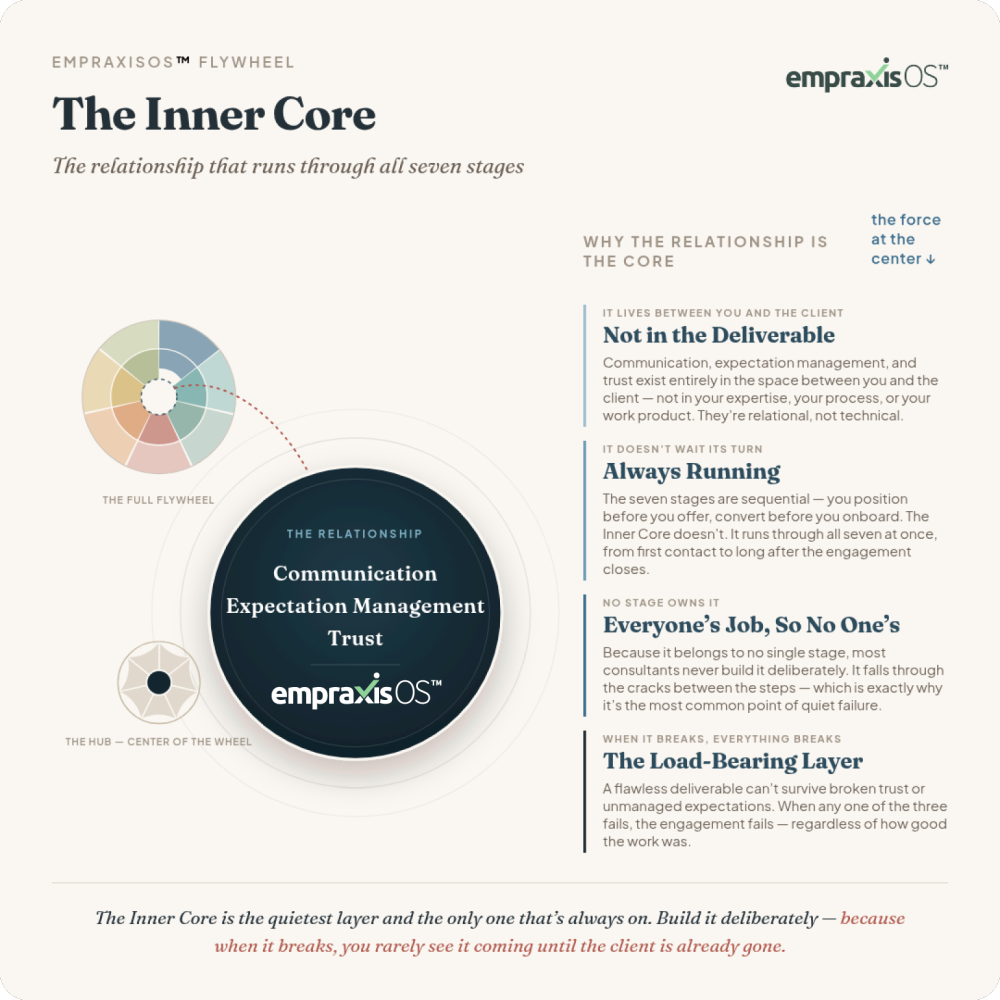
The Inner Core sits at the center of the Flywheel, and runs through every stage
The center
What the Inner Core actually is
The center of the flywheel is occupied by three things: communication, expectation management, and trust. These three aren't stages. They don't have a defined start and end. They don't belong to Position or Deliver or Grow. They run underneath every stage at once, from the moment a client considers hiring you to the moment the engagement closes, and sometimes well beyond.
That's what makes them different from everything else in the system. Everything in the Outer Core is sequential. You position before you offer. You convert before you onboard. There's an order. But communication, expectation management, and trust don't wait their turn. They're active at every moment of the relationship, which is exactly why they sit at the center.
Remember why this layer carries the Earth’s name: the inner core isn’t a stage the planet passes through. It's the persistent force that makes everything else possible. The same is true here. The Inner Core doesn't pause when you're in Attract and resume in Deliver. It runs the whole time.
The three
Why three, and why these three
The Inner Core could theoretically hold a dozen relational qualities: empathy, responsiveness, honesty, flexibility, transparency. The list goes on, and you could argue that some matter more than others. So why communication, expectation management, and trust specifically?
The answer is that these three are the only relational elements that exist entirely in the space between you and the client. Not in your deliverable, not in your expertise, not in your process. They're structural. And they are a different kind of thing from every other quality you might name. Empathy is a tool that enables communication. Responsiveness is a behavior that builds trust. Honesty is a component of expectation management. Every other relational quality, traced back far enough, is either a sub-component or an enabler of one of these three. Communication, expectation management, and trust are the roots. Everything else grows from them.
They're also the three things a client experiences directly, even when everything else is invisible to them. A client may never understand how you diagnosed their problem, structured your proposal, or managed scope. But they absolutely feel whether you communicated proactively, whether their expectations were managed well, and whether they can trust you. These three are the client-facing surface of your internal character. And there's one more reason: when any one of them fails, the engagement fails, regardless of the quality of the deliverable.
The orphan
Why they aren't a natural part of the work
Here's the problem with the Inner Core: no stage owns it. When you're working through Onboard, setting up goals and roles, getting the early win, building the project infrastructure, communication, expectation management, and trust are all active. But they're not on the checklist. They're not a line item in the proposal. No one reviews the engagement afterward and says, "you scored a 7 out of 10 on expectation management."
What they will say is: "I felt like I never really knew what was happening." Or: "I thought we were aligned on scope, but apparently not." Or: "I just wasn't sure I could trust his judgment." Those are the Inner Core failing. But because they fail invisibly, inside a stage that was technically running, they get blamed on the wrong cause. The client thinks the problem was the deliverable. You think the problem was the scope. Neither of you names the actual source.
This is the structural reason the Inner Core gets neglected. No stage owns it, so no one builds it. It's nobody's job, and in consulting, things that are nobody's job don't get done.
David Maister, Charles Green, and Robert Galford named this pattern clearly in The Trusted Advisor. Their work found that professionals consistently prioritize technical competence, the visible, measurable, credential-bearing part of the job, at the expense of the relational infrastructure that actually drives client loyalty. As they put it:
The key to professional success is the ability to earn the trust and confidence of clients. The creation of trust is what earns the right to influence clients; trust is also at the root of client satisfaction and loyalty.
Maister, Green & Galford — The Trusted Advisor
Not technical mastery. Trust. The credential gets you in the room. The relationship determines whether you stay.
Definitions
The three pillars, defined
The three pillars of the Inner Core
Pillar one · Communication
Communication is not the same as being responsive. Responsiveness is reactive: you answer when someone asks. Communication is proactive: you tell people what they need to know before they have to ask.
The distinction matters enormously. A client who has to chase you for updates is a client slowly losing confidence, even if the work is excellent. Every unanswered question, every week without a status update, every meeting that ends without a clear next step, these are small withdrawals from the trust account. They add up.
On that ecommerce project I did not send a single proactive update. Not one. I was heads-down and producing, which felt like the responsible thing to do, and it meant the client had no idea how it was going unless they asked. A weekly update would have cost me twenty minutes and it would have surfaced the new department months before they walked in, because somebody on that thread would eventually have said the words has anyone looped in operations?
What communication actually looks like in an engagement:
A weekly update that goes out whether or not there's news.
A clear agenda before every meeting, and a written summary after.
Proactively flagging problems before the client notices them.
Being the one who sets the communication cadence, not the one who reacts to it.
Chris Voss spent twenty-four years as the FBI's lead hostage negotiator. His work was built almost entirely on communication, specifically on the discipline of listening before talking. In Never Split the Difference, he makes a point that lands directly in consulting:
It all starts with the universally applicable premise that people want to be understood and accepted. Listening is the cheapest, yet most effective concession we can make to get there.
Chris Voss — Never Split the Difference
Most consultants think of communication as the things they say: the updates, the reports, the presentations. Voss's point is that communication begins with what you hear. A client who feels genuinely listened to is a client who will tell you things, and a client who tells you things is a client you can actually help. As he puts it, "listening is not a passive activity. It is the most active thing you can do." Most consultants are communicating. Very few are listening at this level. The ones who do tend to know things about their clients their competitors don't, and that knowledge shows up in the quality of every recommendation.
Pillar two · Expectation Management
This is the most misunderstood of the three. Most consultants think of it as scope management: keeping the client from asking for things they didn't pay for. That's one application, but a narrow one. The real job is much bigger.
Every client walks into an engagement with a mental model of how it's going to go. Expectations about how often you'll communicate. About when results will show up. About what "done" looks like. About how much access they'll have to you. About how much disruption the work will cause. Most of these have never been spoken aloud; they're implicit, carried from past experiences or simply assumed. Your job is to surface those expectations, validate the realistic ones, and reset the unrealistic ones before the engagement starts, not after a problem appears.
The expectations that killed my ecommerce project were never in the room. They belonged to a department I did not know existed, held by people I had never met, and by the time I heard them we were too far along to absorb them. I never asked who else had to say yes. That question takes ten seconds and I did not think to ask it, because I believed my job started once the requirements were handed to me.
Maister and his co-authors offer a sharp formulation for why this is so hard:
Our clients have no way to observe sincerity except through external behaviors. From certain behaviors (attention paid, interest shown, advance work done, empathetic listening), we infer the internal state we call sincerity.
The Trusted Advisor
The client cannot see your intentions. They can only see your behaviors. If your behavior signals "I'm on top of this," they feel confident. If it signals "I'm not sure what's next," they feel anxious, even if you're privately certain. Expectation management is the discipline of making sure your behavior consistently signals what you actually mean. Reliability, as they describe it, is simply the repeated experience of links between promises and action. You make a promise. You follow through. You do it again. Break that cycle once or twice and you begin paying what Stephen M.R. Covey calls a trust tax.
What expectation management looks like in an engagement:
A kickoff conversation that surfaces the client's assumptions, not just the project goals.
A written scope that defines what's in as clearly as it defines what's out.
A cadence reset conversation at the start of every new phase.
Proactively naming what the next thirty days will and won't look like, before the client has to wonder.
Pillar three · Trust
Trust is the culmination. You build it through consistent communication and reliable expectation management, and then it either compounds or erodes depending on everything else that happens in the relationship.
It's also the most misunderstood of the three in professional services. Most consultants think of trust as something earned through competence: delivering excellent work, demonstrating expertise, showing results. Competence is necessary. It is not sufficient.
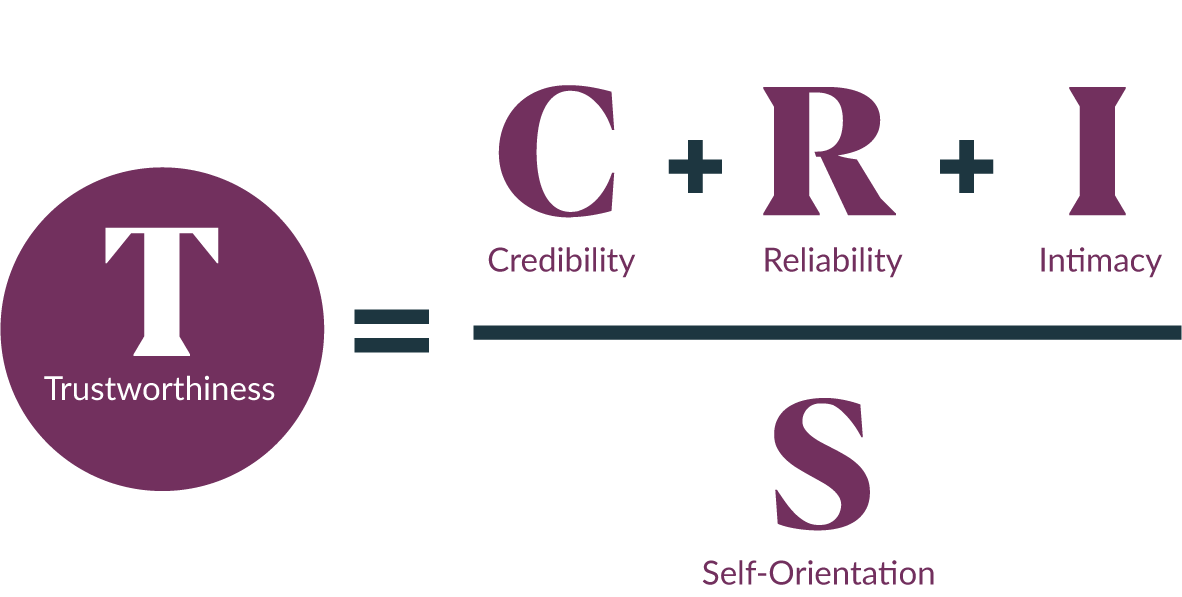
Maister, Green, and Galford offer a precise formula: trustworthiness equals credibility times reliability times intimacy, all divided by self-orientation. The denominator is the critical piece.
A common trait of all these trusted advisor relationships is that the advisor places a higher value on maintaining and preserving the relationship itself than on the outcomes of the current transaction, financial or otherwise.
The Trusted Advisor
When the client senses you're more interested in protecting your revenue than in helping them, trust deflates, even if you've never said anything to suggest it, and even if you've delivered excellent work. Self-orientation is felt. Clients are remarkably good at detecting whose interests a consultant is actually serving.
Much of empraxisOS stems from this one idea.
Stephen M.R. Covey frames the consequence clearly in The Speed of Trust:
When trust goes down in a relationship, company, or culture… speed will go down and cost will go up… Significant distrust doubles the cost of doing business and triples the time it takes to get things done.
Stephen M.R. Covey — The Speed of Trust
In consulting terms: low trust means more check-ins, more approvals, more scope disputes, more defensive documentation, more time spent managing the relationship instead of serving the client. High trust means faster decisions, more candid conversations, more latitude to do your best work, and more referrals at the end. Trust always moves two things: speed and cost. When trust falls, speed falls and cost rises. When trust rises, speed rises and cost falls. The math is real.
Patrick Lencioni argues in Getting Naked that the fastest path to trust is not competence or credentials, but the willingness to be vulnerable in front of a client. That runs counter to how most of us think about our professional image. The instinct is to project confidence and expertise.
The practical translation runs the other way. Tell the client when you don’t know something. Name the risk in a recommendation. Ask the question that reveals a gap in your understanding. Admit when you got something wrong before they notice. Every one of these costs your ego something, and every one earns your client’s trust, which is more durable than any deliverable.
What trust looks like in an engagement:
Being the one who names the problem in the room, not the one who waits to be asked.
Giving an honest assessment even when it's not what the client hoped to hear.
Following through on the small commitments, the ones nobody's tracking, as consistently as the large ones.
Staying in the relationship through difficulty instead of retreating into process.
Here is what I understand now about that project. Every hard conversation I avoided, I avoided because the relationship was not strong enough to hold one. I had done good work, and good work counts for something. But being good at your job is only one part of trust, and it was the only part I had built. I never built the kind of relationship where I could say this is outside what we agreed to and have it land as partnership rather than as a complaint. So I said nothing, and absorbed it, and the absence of that one conversation cost me the engagement.
The Trust Equation. Source: trustedadvisor.com
The stakes
Why this matters more than your methodology
Here's the hard truth about the Inner Core: clients will forgive imperfect methodology. They'll forgive scope that didn't anticipate every variable. They'll forgive deliverables that needed a second pass. What they almost never forgive is feeling unheard, blindsided, or unable to trust the person they hired.
Every consultant who has ever lost a client they thought was happy lost them in the Inner Core. I know, because I did. In most cases the deliverable was fine and the methodology was reasonable. But somewhere in the engagement, communication slipped, or expectations misaligned and were never corrected, or a moment came where trust was needed and wasn't there. The Inner Core doesn't protect you from every client problem. But its absence makes every other problem fatal.
The recap
Chapter 3 in review
The Inner Core is communication, expectation management, and trust. It is not the soft part of the job, it is the layer that decides whether everything above it works.
No stage owns it. It never appears on a checklist or in a proposal, and in consulting, things that are nobody's job do not get done.
It fails invisibly, which is why it gets misdiagnosed. The client blames the deliverable, you blame the scope, and neither of you names the actual source.
Communication is not responsiveness. Responsiveness answers when asked. Communication tells the client what they need to know before they have to ask, and it begins with listening rather than talking.
Expectation management is not scope defense. Every client arrives with an unspoken picture of how this will go, and your job is to surface it before the engagement starts, not after a problem appears.
Trust is not earned by competence alone. Credibility, reliability, and intimacy all divide by self-orientation, and clients are remarkably good at sensing whose interests you are actually serving.
The start
Where to begin
The Inner Core isn't built in one conversation or one deliverable. It's built in the accumulation of small, consistent behaviors across an engagement, and across many engagements over time. Here's where to start.
On communication: set the cadence on day one and own it. Don't wait for the client to ask what's happening. Decide in advance how often you'll update them, in what format, and what the update will contain. Then do it consistently, even when there's nothing dramatic to report. Especially then.
On expectation management: before every engagement, run an expectations conversation that goes beyond the scope document. Ask: what does success look like to you at the end of this? What are you most worried about? What has gone wrong with engagements like this before? Their answers tell you exactly what you need to manage, and most of it never appears in the brief.
On trust: lower the shield earlier than feels comfortable. Name your uncertainty. Ask the question that reveals what you don't know. Tell the client the inconvenient thing before it becomes a problem. Every time you do this and the relationship holds, and it almost always holds, you've deposited something no invoice can quantify.
The Outer Core: The Seven Stages and Why This Order Matters
Seven stages, running in sequence — each one dependent on the one before it, and what breaks when you skip one.
Chapter 4 of 15· 12 min read
On this page
The Inner Core, communication, expectation management, and trust, is the force that powers everything. But a force needs something to move through. That's the Outer Core.
Seven stages, arranged in a specific sequence, each doing a different job. The sequence isn't arbitrary; it's structural. Change the order and the system stops working. Skip a stage and you pay for it later, usually in a way that looks unrelated to the stage you skipped.
You have run all seven of these at some point. Everyone has. What almost nobody does is run them deliberately, in order, with a defined process for each. That is the difference between a practice that compounds and one that resets to zero with every new client.
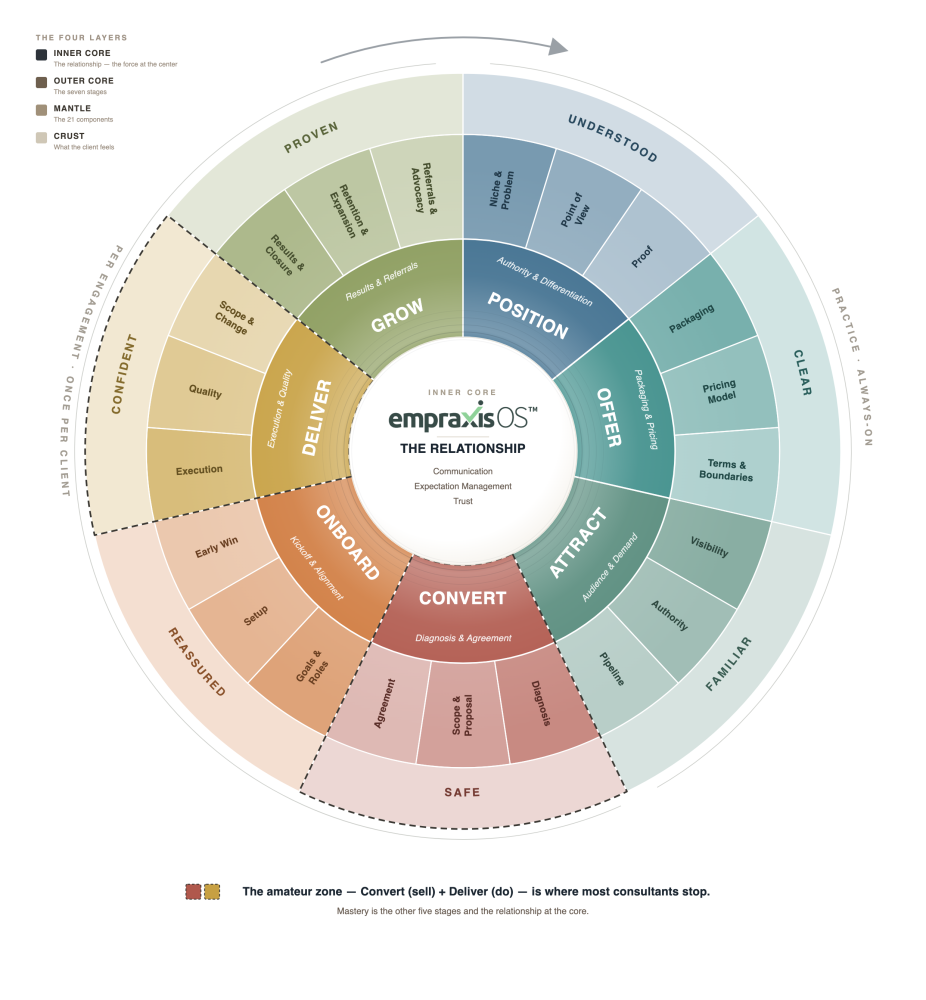
The Outer Core holds the seven stages of the Flywheel
The ring
What the seven stages are
The Outer Core holds Position, Offer, Attract, Convert, Onboard, Deliver, and Grow. Not eight. Not five. Seven. Each is a distinct discipline: a different type of work, a different skill set, a different deliverable, a different failure mode.
Position makes you recognizable. Without it, everything downstream starts from zero credibility every single time.
Offer makes what you do purchasable. Without it, you explain yourself from scratch on every call, price by intuition, and lose deals to consultants who are less capable but easier to understand.
Attract generates demand rather than waiting for it. Without it, your practice depends on whoever happens to refer you this month. That is not a pipeline. That is a lottery.
Convert turns interest into agreement. Diagnosis, Scope & Proposal, Agreement: three disciplines most of us collapse into one undifferentiated sales call. Without it, your close rate is inconsistent and you cannot say why.
Onboard starts the work well. Without it, the client's anxiety peaks at exactly the moment you go quiet to begin, and confidence lost in the first two weeks is expensive to recover.
Deliver executes with quality, and visibly. Without it as a defined stage, scope creep is inevitable and quality depends on the week.
Grow ends well and starts again. Without it, the engagement closes and the pipeline empties, and you start the flywheel from a standing stop.
The Outer Core: seven stages, in sequence
The logic
Why this sequence and not another
The order isn't decorative. Each stage depends on the one before it being in place, and that is the piece most of us miss.
You cannot build an Offer before you have Positioned. An Offer without a Position describes what you do but not who it is for or why you specifically, and a generic offer cannot command a premium because there is nothing to anchor the premium to.
You cannot Attract without an Offer. Attract draws people toward something. If they cannot immediately understand what they would be buying and whether it is for them, you generate curiosity instead of pipeline. Tire kickers, not prospects.
You cannot Convert without having Attracted. Conversion requires someone to convert. Without Attract you are either cold calling into silence or living entirely on referrals, which means your pipeline depends on whether someone happens to remember you at the right moment.
You cannot Onboard a client you have not Converted. What is less obvious is that the quality of your Convert determines the ease of your Onboard. A client who signed without full clarity on scope shows up already anxious and already negotiating. The problems that surface in Onboard were almost always created in Convert.
You cannot Deliver well without having Onboarded well. Delivery without a solid Onboard is execution without alignment: the client does not know what success looks like, and you do not know what they value most. The work comes out technically correct and relationally incomplete.
And you cannot Grow without having Delivered. Referrals, retention, and expansion are all downstream of a client with a real result they can point to. You cannot manufacture advocacy from an engagement that underdelivered.
The sequence is causal. Each stage produces the conditions the next one requires.
None of that needs to stick right now. You are not meant to memorize seven stages and their dependencies from one pass, and there is nothing to build yet. Each of these gets its own chapter, with the pillars underneath it and the failures that come with it, and you will meet them one at a time with plenty of room. For now all that matters is the shape.
Michael Gerber spent decades studying why small businesses fail. His conclusion in The E-Myth Revisited was that most people who start a business are technicians, deeply skilled at the work, who make one fatal assumption: that understanding the technical work of a business means you can run a business that does that work. The consulting version is assuming that being excellent at Deliver is enough.
“If your business depends on you, you don’t own a business, you have a job. And it’s the worst job in the world because you’re working for a lunatic.” Michael Gerber, The E-Myth Revisited
Seven stages, run deliberately, in sequence, is what turns the job into a business.
The trap
Why the order breaks when you skip a stage
Here is the problem skipping creates: the symptom never appears in the stage you skipped. It appears downstream, in a stage you did run, and it looks like a failure there.
You skip Position and go straight to Offer. Eventually you notice you close at inconsistent rates, even on calls that seemed to go well, so you assume the problem is your sales process and you go to work on Convert. But without a clear Position you are attracting the wrong prospects. Some fit, some do not, and you have no reliable way to tell before you have already spent an hour on a call. Convert looks broken. Position is the gap.
You skip Onboard. You sign the contract and move straight into the work, and eventually you lose a client you thought was happy. What you get is something vague. It just wasn't the right fit. I don't think we were aligned. So you file it under personality mismatch or bad luck. But that client arrived in Delivery carrying unresolved questions and unmet expectations that Onboard existed to surface. Deliver looks like the failure. Onboard is the gap.
You skip Grow. You close engagements without a real results conversation, without asking for referrals, without planting anything for the future, and you find yourself restarting your pipeline from near zero after every project. So you assume you have an Attract problem. But Grow feeds Attract directly. The referrals and proof it produces are the most efficient pipeline inputs available to you. The pipeline problem is a Grow problem.
For most consultants, the gaps cluster in the same place: Position, Offer, and Attract. Which is why the practice runs on referrals and relationships, and why business is good while those networks are active and everything goes quiet when they are not.
The demonstration
Tracing one backward
I told you about the ecommerce project I lost.
For years I filed that under Deliver. It fell apart during the build, so I assumed it was a delivery problem, and I got better at delivery. It never happened again in the same form, and it kept happening in other forms.
Walk it backward now. The engagement broke when a department nobody had accounted for arrived with requirements that were never in scope. That looks like a Deliver failure and it is not. Scope was never reconciled with everyone who had a say, which is Convert. And nobody with a say was ever identified, which happens in Onboard, in the conversation about goals and roles I never had.
Trace it further and it goes further back still. I never asked who else had to say yes, because I did not think of myself as someone who directed an engagement. I thought of myself as someone who executed one.
Every hour I spent getting better at Deliver was an hour spent reinforcing the one stage that was already working.
The symptom never appears in the stage you skipped.
Altitude
The two altitudes, and why both matter
The seven stages split into two altitudes: three that run always-on at the practice level, and four that run once per client at the engagement level. That split matters more than it looks, because the two sets fail in completely different ways.
The practice-level stages fail through neglect. No client is demanding them today, no deadline is attached, and they are the first thing to disappear when an engagement gets intense. Gerber named it precisely: go to work on your business rather than in it. Position, Offer, and Attract are the business. The engagement stages are the job.
The engagement-level stages fail through inconsistency. Convert, Onboard, Deliver, and Grow happen with every client, but without a defined process they run differently each time. One Onboard is thorough, the next is rushed. One project has weekly updates and clear scope management, the next goes quiet for three weeks and then surfaces a dispute.
That inconsistency is not laziness. It is the absence of a system, and without a system, quality depends entirely on how much time you had and how demanding the client was. That is not a practice. That is improvisation.
The whole system
What running all seven looks like
A practice running all seven stages in order is a different organism than one running two or three. It has a position that makes the right prospects self-select. An offer that makes scope and price legible before the first call. Pipeline that does not depend on who happened to call this week. It converts at a consistent rate because the diagnosis is defined and the proposal follows a structure. It starts engagements in a way that resolves anxiety before the work begins. It delivers with quality and visibility. And it closes with documentation, retention conversations, and intentional referral asks, producing the proof that feeds the next cycle.
That is the flywheel in motion. It does not happen all at once. Most consultants build the Outer Core one stage at a time, starting wherever the biggest gap is. But the direction of travel is always the same: toward a complete system, running in sequence, compounding over time.
The recap
Chapter 4 in review
The 7 stages are not a checklist. Each one produces the conditions the next one requires, which is why the sequence is causal rather than decorative.
You cannot Offer without a Position to anchor it, cannot Attract without something to draw people toward, and cannot Grow from an engagement that underdelivered. The chain runs in one direction.
When you skip a stage, the symptom never shows up where you skipped. It shows up downstream, in a stage you did run, and it looks like a failure there.
Inconsistent close rates usually mean a Position problem, not a Convert problem. A client lost to "not the right fit" usually means a missing Onboard. A pipeline that restarts from zero usually means a missing Grow.
The 3 practice-level stages fail from neglect because nobody demands them. The 4 engagement-level stages fail from inconsistency because you run them every time without a defined way of doing them.
Being excellent at Deliver does not build a practice. It builds a very expensive job.
The start
Where to begin
Do not try to fix a stage yet. Take the last engagement that went sideways, the one that still bothers you a little, and write down where you think it broke. Then walk the sequence backward from there, one stage at a time, asking what that stage needed from the one before it. Almost every time, the real gap sits one or two stages upstream of where the pain showed up. Find that stage. That is the one to build first, and you now know why every attempt to fix it at the point of pain never held.
Twenty-one components — three per stage. The layer that turns a framework you admire into a system you can actually run.
Chapter 5 of 15· 13 min read
On this page
The Inner Core, communication, expectation management, and trust, is the force that powers everything. But a force needs something to move through. That's the Outer Core.
Seven stages, arranged in a specific sequence, each doing a different job. The sequence isn't arbitrary; it's structural. Change the order and the system stops working. Skip a stage and you pay for it later, usually in a way that looks unrelated to the stage you skipped.
You have run all seven of these at some point. Everyone has. What almost nobody does is run them deliberately, in order, with a defined process for each. That is the difference between a practice that compounds and one that resets to zero with every new client.
The Outer Core holds the seven stages of the Flywheel
The ring
What the seven stages are
The Outer Core holds Position, Offer, Attract, Convert, Onboard, Deliver, and Grow. Not eight. Not five. Seven. Each is a distinct discipline: a different type of work, a different skill set, a different deliverable, a different failure mode.
Position makes you recognizable. Without it, everything downstream starts from zero credibility every single time.
Offer makes what you do purchasable. Without it, you explain yourself from scratch on every call, price by intuition, and lose deals to consultants who are less capable but easier to understand.
Attract generates demand rather than waiting for it. Without it, your practice depends on whoever happens to refer you this month. That is not a pipeline. That is a lottery.
Convert turns interest into agreement. Diagnosis, Scope & Proposal, Agreement: three disciplines most of us collapse into one undifferentiated sales call. Without it, your close rate is inconsistent and you cannot say why.
Onboard starts the work well. Without it, the client's anxiety peaks at exactly the moment you go quiet to begin, and confidence lost in the first two weeks is expensive to recover.
Deliver executes with quality, and visibly. Without it as a defined stage, scope creep is inevitable and quality depends on the week.
Grow ends well and starts again. Without it, the engagement closes and the pipeline empties, and you start the flywheel from a standing stop.
The Outer Core: seven stages, in sequence
The logic
Why this sequence and not another
The order isn't decorative. Each stage depends on the one before it being in place, and that is the piece most of us miss.
You cannot build an Offer before you have Positioned. An Offer without a Position describes what you do but not who it is for or why you specifically, and a generic offer cannot command a premium because there is nothing to anchor the premium to.
You cannot Attract without an Offer. Attract draws people toward something. If they cannot immediately understand what they would be buying and whether it is for them, you generate curiosity instead of pipeline. Tire kickers, not prospects.
You cannot Convert without having Attracted. Conversion requires someone to convert. Without Attract you are either cold calling into silence or living entirely on referrals, which means your pipeline depends on whether someone happens to remember you at the right moment.
You cannot Onboard a client you have not Converted. What is less obvious is that the quality of your Convert determines the ease of your Onboard. A client who signed without full clarity on scope shows up already anxious and already negotiating. The problems that surface in Onboard were almost always created in Convert.
You cannot Deliver well without having Onboarded well. Delivery without a solid Onboard is execution without alignment: the client does not know what success looks like, and you do not know what they value most. The work comes out technically correct and relationally incomplete.
And you cannot Grow without having Delivered. Referrals, retention, and expansion are all downstream of a client with a real result they can point to. You cannot manufacture advocacy from an engagement that underdelivered.
The sequence is causal. Each stage produces the conditions the next one requires.
None of that needs to stick right now. You are not meant to memorize seven stages and their dependencies from one pass, and there is nothing to build yet. Each of these gets its own chapter, with the pillars underneath it and the failures that come with it, and you will meet them one at a time with plenty of room. For now all that matters is the shape.
Michael Gerber spent decades studying why small businesses fail. His conclusion in The E-Myth Revisited was that most people who start a business are technicians, deeply skilled at the work, who make one fatal assumption: that understanding the technical work of a business means you can run a business that does that work. The consulting version is assuming that being excellent at Deliver is enough.
“If your business depends on you, you don’t own a business, you have a job. And it’s the worst job in the world because you’re working for a lunatic.” Michael Gerber, The E-Myth Revisited
Seven stages, run deliberately, in sequence, is what turns the job into a business.
The trap
Why the order breaks when you skip a stage
Here is the problem skipping creates: the symptom never appears in the stage you skipped. It appears downstream, in a stage you did run, and it looks like a failure there.
You skip Position and go straight to Offer. Eventually you notice you close at inconsistent rates, even on calls that seemed to go well, so you assume the problem is your sales process and you go to work on Convert. But without a clear Position you are attracting the wrong prospects. Some fit, some do not, and you have no reliable way to tell before you have already spent an hour on a call. Convert looks broken. Position is the gap.
You skip Onboard. You sign the contract and move straight into the work, and eventually you lose a client you thought was happy. What you get is something vague. It just wasn't the right fit. I don't think we were aligned. So you file it under personality mismatch or bad luck. But that client arrived in Delivery carrying unresolved questions and unmet expectations that Onboard existed to surface. Deliver looks like the failure. Onboard is the gap.
You skip Grow. You close engagements without a real results conversation, without asking for referrals, without planting anything for the future, and you find yourself restarting your pipeline from near zero after every project. So you assume you have an Attract problem. But Grow feeds Attract directly. The referrals and proof it produces are the most efficient pipeline inputs available to you. The pipeline problem is a Grow problem.
For most consultants, the gaps cluster in the same place: Position, Offer, and Attract. Which is why the practice runs on referrals and relationships, and why business is good while those networks are active and everything goes quiet when they are not.
The demonstration
Tracing one backward
I told you about the ecommerce project I lost.
For years I filed that under Deliver. It fell apart during the build, so I assumed it was a delivery problem, and I got better at delivery. It never happened again in the same form, and it kept happening in other forms.
Walk it backward now. The engagement broke when a department nobody had accounted for arrived with requirements that were never in scope. That looks like a Deliver failure and it is not. Scope was never reconciled with everyone who had a say, which is Convert. And nobody with a say was ever identified, which happens in Onboard, in the conversation about goals and roles I never had.
Trace it further and it goes further back still. I never asked who else had to say yes, because I did not think of myself as someone who directed an engagement. I thought of myself as someone who executed one.
Every hour I spent getting better at Deliver was an hour spent reinforcing the one stage that was already working.
The symptom never appears in the stage you skipped.
Altitude
The two altitudes, and why both matter
The seven stages split into two altitudes: three that run always-on at the practice level, and four that run once per client at the engagement level. That split matters more than it looks, because the two sets fail in completely different ways.
The practice-level stages fail through neglect. No client is demanding them today, no deadline is attached, and they are the first thing to disappear when an engagement gets intense. Gerber named it precisely: go to work on your business rather than in it. Position, Offer, and Attract are the business. The engagement stages are the job.
The engagement-level stages fail through inconsistency. Convert, Onboard, Deliver, and Grow happen with every client, but without a defined process they run differently each time. One Onboard is thorough, the next is rushed. One project has weekly updates and clear scope management, the next goes quiet for three weeks and then surfaces a dispute.
That inconsistency is not laziness. It is the absence of a system, and without a system, quality depends entirely on how much time you had and how demanding the client was. That is not a practice. That is improvisation.
The whole system
What running all seven looks like
A practice running all seven stages in order is a different organism than one running two or three. It has a position that makes the right prospects self-select. An offer that makes scope and price legible before the first call. Pipeline that does not depend on who happened to call this week. It converts at a consistent rate because the diagnosis is defined and the proposal follows a structure. It starts engagements in a way that resolves anxiety before the work begins. It delivers with quality and visibility. And it closes with documentation, retention conversations, and intentional referral asks, producing the proof that feeds the next cycle.
That is the flywheel in motion. It does not happen all at once. Most consultants build the Outer Core one stage at a time, starting wherever the biggest gap is. But the direction of travel is always the same: toward a complete system, running in sequence, compounding over time.
The recap
Chapter 4 in review
The 7 stages are not a checklist. Each one produces the conditions the next one requires, which is why the sequence is causal rather than decorative.
You cannot Offer without a Position to anchor it, cannot Attract without something to draw people toward, and cannot Grow from an engagement that underdelivered. The chain runs in one direction.
When you skip a stage, the symptom never shows up where you skipped. It shows up downstream, in a stage you did run, and it looks like a failure there.
Inconsistent close rates usually mean a Position problem, not a Convert problem. A client lost to "not the right fit" usually means a missing Onboard. A pipeline that restarts from zero usually means a missing Grow.
The 3 practice-level stages fail from neglect because nobody demands them. The 4 engagement-level stages fail from inconsistency because you run them every time without a defined way of doing them.
Being excellent at Deliver does not build a practice. It builds a very expensive job.
The start
Where to begin
Do not try to fix a stage yet. Take the last engagement that went sideways, the one that still bothers you a little, and write down where you think it broke. Then walk the sequence backward from there, one stage at a time, asking what that stage needed from the one before it. Almost every time, the real gap sits one or two stages upstream of where the pain showed up. Find that stage. That is the one to build first, and you now know why every attempt to fix it at the point of pain never held.
The seven responses the client feels — and the loop back to the center.
Chapter 6 of 15· 13 min read
On this page
The client
None of this happens without them
You went out on your own for your own reasons. Freedom. Autonomy. Money, maybe. The chance to build something that was actually yours, and to stop asking permission to do work you already knew how to do.
Every one of those is a good reason. I had most of them myself.
And not a single one of them happens without clients.
You have probably heard some version of this before: what you earn is proportional to the problems you solve. It sounds like something printed on a poster until you take it literally, and then it turns into something useful.
Because problems do not float around on their own. They belong to people. A company does not have a problem. Someone inside that company has one, it is costing them something, and they have been carrying it long enough that they have started looking for help.
That is the whole job. Not deliverables. Not expertise in the abstract. Real problems, belonging to real people, solved well enough that they would tell somebody else about it.
Which means the person on the other side of the work is not a step on the way to the practice you want. They are the practice.
Now, let me be clear about what this is not. This is not an argument that the client is always right, or that you should bend over backwards, drop your rates, answer at midnight, or absorb whatever arrives. You do not owe anyone your dignity or your evenings. A practice built on appeasement is just a job with worse benefits.
What I am arguing for is intentionality. Consideration. Thoughtfulness about the person on the other side of the work, applied on purpose and early, when it is still cheap.
Because your client is having an experience of working with you whether or not you designed one. That experience is happening in them, not in the deliverable, and it is the thing that decides whether they stay, whether they refer you, and whether the practice you left everything for actually holds.
That is what this layer is.
The surface
What the Crust actually is
Most consultants think of client satisfaction as a result: something that happens when the work is good. The Crust reframes that entirely. What sits on the outer rim of the flywheel is not a measure of how the client feels about you. It is seven specific responses, engineered into the system because they are the ones that keep an engagement on track when present, and signal that something beneath is breaking down when absent.
That distinction, between a result that happens to you and a response you design the system to produce, is what this chapter is about.
The word "feelings" is imprecise and easy to dismiss. Feelings are variable, subjective, hard to target, and nearly impossible to diagnose when they go wrong. That's not what these seven words are. The Crust holds seven engineered client responses. Not the full range of what a client might experience across an engagement; there are dozens of those. These seven were identified through real consulting work as the specific responses that separate nightmare engagements from dream clients and bad projects from successful ones. Not because they feel good, but because of what their presence or absence predicts.
When a client feels Understood after Position, the engagement starts with real alignment. When they feel Clear after Offer, the scope conversation goes smoothly. When they feel Familiar after Attract, hiring you doesn't feel like a risk. When they feel Safe after Convert, they sign without reservations and show up to Onboard ready to work. When they feel Reassured after Onboard, they stop managing you and let you lead. When they feel Confident during Deliver, they stop checking in anxiously and start trusting the process. When they feel Proven at the close of Grow, they have a result they can point to and a story they can tell. Seven responses. One per stage. Each engineered to be the output of a stage done well.
Stage
The engineered response
Position
Understood
Offer
Clear
Attract
Familiar
Convert
Safe
Onboard
Reassured
Deliver
Confident
Grow
Proven
B. Joseph Pine and James H. Gilmore made an observation in The Experience Economy that gets at the heart of what the Crust represents:
While prior economic offerings, commodities, goods, and services, are external to the buyer, experiences are inherently personal, existing only in the mind of an individual who has been engaged on an emotional, physical, intellectual, or even spiritual level.
Pine & Gilmore — The Experience Economy
In consulting, the deliverable is external. The report, the strategy, the plan, the implementation exist outside the client. But the engagement exists inside them. The experience of being diagnosed, proposed to, onboarded, and delivered to happens in the client's mind, not on the page. The Crust is the system's acknowledgment of that reality. It asks not just "was the deliverable correct?" but "did the client experience what this stage was designed to produce?"
The words
Why these seven words and not others
Precision matters here. Each word was chosen because it names the specific response that signals the stage worked, not a general positive reaction, but the exact one.
Position doesn't need the client to feel impressed. It needs them to feel Understood: that before a proposal was ever written, before a scope was defined, before anything was sold, you got their problem. Not the surface version. The real version. Offer doesn't need the client to feel excited; excitement is unreliable and doesn't survive contact with the invoice. It needs them to feel Clear: that they know exactly what they're buying, what it costs, and what it doesn't include. Attract doesn't need the client to feel impressed by your content. It needs them to feel Familiar: that they've seen enough of how you think that hiring you doesn't feel like a risk.
Convert doesn't need the client to feel confident; that comes later. It needs them to feel Safe: that signing this agreement is the right call, that they're not taking an unnecessary risk, that if something goes sideways they'll be in the hands of someone who will handle it well. Onboard doesn't need the client to feel excited about the work ahead. It needs them to feel Reassured: that the anxiety of having just made a significant decision has been addressed directly, that they understand what happens next, that they know who to call. Deliver doesn't need the client to feel busy. It needs them to feel Confident: that the work is running well, that the consultant is in control, that the result is coming. And Grow doesn't need the client to feel grateful. It needs them to feel Proven: that they made a smart decision, that there is a documented result they can point to, that the investment was worth it. Proven is the response that produces referrals, not gratitude.
Robert Cialdini spent decades studying the psychology of human decision-making. His finding in Influence on what happens once a commitment is made applies directly to why these responses matter at each stage:
Once we have made a choice or taken a stand, we will encounter personal and interpersonal pressures to behave consistently with that commitment. Those pressures will cause us to respond in ways that justify our earlier decision.
Robert Cialdini — Influence
A client who feels Safe at Convert will justify that feeling. They'll show up to Onboard ready to work, willing to trust the process, inclined to give the consultant latitude. A client who signed without feeling Safe will do the opposite: they'll second-guess, over-manage, and look for evidence that they made the wrong call. The signed contract is identical in both cases. The Crust response at Convert determines which engagement begins.
The loop
The Crust feeds the Inner Core
Here is the structural insight the previous chapters have been building toward, and it's the most important argument in the book so far. The Crust isn't the output of the system. It's the feedback loop back into the center.
Most consultants think of the Inner Core, communication, expectation management, and trust, as something they build deliberately at the beginning of an engagement and then maintain. That's partially right. But the fuller truth is that the Inner Core is rebuilt, stage by stage, by every Crust response the engagement produces.
When a client feels Understood after Position, they communicate more openly in every conversation that follows. They tell you the real problem, not the version they thought you wanted to hear. That openness is a communication deposit, paid directly into the Inner Core. When a client feels Clear after Offer, their expectations arrive already aligned; there are no hidden assumptions to manage later because the Offer stage surfaced and resolved them. That clarity is an expectation management deposit, made before the work even starts. When a client feels Safe after Convert, they extend trust before it's been fully earned through delivery. They sign and stop negotiating mentally. They give you latitude to make judgment calls. That trust deposit, made at the moment of commitment, changes the character of everything that follows. When a client feels Reassured after Onboard, they stop managing you and start working with you. The anxious phone calls don't come because the anxiety was addressed. The relationship shifts from transactional to collaborative, and that shift is an Inner Core event, not a delivery event.
This is the loop. Every Crust response, produced correctly, feeds the three elements of the Inner Core. Every stage adds to the relationship balance that makes the next stage easier to run. By the time a client reaches Deliver feeling Confident, they're not just satisfied with the work so far; they're in an entirely different quality of relationship than the client who arrived at Deliver having missed Safe at Convert and Reassured at Onboard.
Our job as consultants isn't the project. The project is the vehicle.
Our job as consultants isn't the project. The project is the vehicle. The job is to serve, advise, and consult in a way that produces a client who trusts us enough to let us do our best work. The Crust is the mechanism by which that trust is built, stage by stage, as a deliberate act of design rather than a hopeful byproduct of good work. And because that experience happens inside a particular person, the Crust cannot be standardized into a script. The seven words are the targets. The specific way each one is produced depends on the client, the engagement, and the relationship. The consultant who knows they're aiming for Reassured at Onboard can customize how they produce it: a detailed written summary, a personal call, a clear first-week plan, whatever that specific client needs to feel it. The Crust names the target. The Inner Core determines the path.
The cascade
What happens when one response is missed
It only takes one. A missed Crust response doesn't just leave a gap. It triggers a cascade through the Inner Core, usually quietly, in ways the consultant doesn't see coming until the engagement is already harder than it should be.
The client who doesn't feel Safe at Convert doesn't just feel nervous. They arrive at Onboard still in decision mode. They're re-evaluating whether they made the right call, which means they're not listening to what Onboard is trying to produce; they're auditing it. The Goals & Roles conversation becomes a negotiation. The Setup phase feels provisional. The Early Win is useful but not reassuring, because they're still not sure this consultant is the right one.
By the time Deliver starts, communication has calcified. The client is asking for more updates than you planned for, because they don't feel confident the work is running well, because they never fully felt Safe and Reassured in the stages that were supposed to produce those responses. Expectation management is harder because the expectations were never fully aligned. Trust is thinner than it should be at this stage, which means every judgment call you make gets second-guessed. None of this shows up in the deliverable. The work is still good. The scope is being met. But the engagement is running on friction, and you do not know why, because you do not have a name for what broke. So you attribute it to the client's personality, or the difficulty of the project, or just the nature of this type of engagement. The actual break was at Convert. One missed response. Everything after it is the cost.
Maister, Green, and Galford put the consequence clearly in The Trusted Advisor: once trust has been lost in a professional relationship, the effort required to rebuild it is significantly greater than what would have been required to build it correctly the first time. The client who didn't feel Safe at Convert doesn't need you to do better work. They need you to re-earn something that should have been established in the Diagnosis and Agreement conversations. That's expensive, in time, in energy, and in the quality of the work that gets done while you're repairing the relationship instead of running the engagement.
This is why the Crust matters as a diagnostic in real time, not just in retrospect. If you're three weeks into Deliver and an engagement feels harder than it should, the question isn't "what can I do better right now?" It's "which Crust response was missed, and what can I do to produce it now?" Sometimes the answer is a direct conversation with the client, naming what they might be feeling and addressing it explicitly. Sometimes it's revisiting a component that was rushed. Sometimes it's going back to a conversation that closed without producing the response it was supposed to produce. The Crust gives you a target to return to. Without it, course correction is guesswork.
Diagnostic
Using the Crust as a diagnostic
After any stage, or at any point when an engagement feels like it's drifting, the seven words are a one-question audit per stage. Does this client feel Understood right now? Do they feel Clear about what they're getting? Did they feel Familiar with how I think before they came into the sales conversation? Did they feel Safe when they signed? Did they feel Reassured after our first two weeks together? Do they feel Confident in the work in progress? Will they feel Proven when we close?
When the answer to any of those is no, or "I'm not sure," the next question is always the same: which Mantle component was supposed to produce that response, and did I run it? The client who doesn't feel Understood usually experienced a Position or Convert stage where Diagnosis was rushed. The client who doesn't feel Safe usually experienced a Convert stage where Agreement was procedural: both parties signed a document, but the conversation that should have preceded the signing, the one where the client's unspoken concerns are named and addressed, never happened. The client who doesn't feel Proven at the close usually experienced a Grow stage where Results & Closure was treated as an administrative step rather than a deliberate conversation. In every case, the Crust word that's missing has an address in the Mantle. That's what makes the system diagnostic rather than merely descriptive.
The thread
The thread that runs through everything
The four architecture chapters are complete. The Inner Core, the relationship that powers everything. The Outer Core, the seven stages and the sequence that makes them work. The Mantle, the twenty-one disciplines that turn the stages into an operating system. The Crust, the seven engineered responses that signal whether the system is running and feed the relationship that makes the next stage easier. These four layers are the architecture. Each stage chapter will return to the Crust at the end, naming the engineered response that stage is designed to produce and connecting it back to the Inner Core elements it feeds. The Crust doesn't disappear after this chapter. It becomes the thread.
Every stage we cover, the question at the end is always the same: did the client feel the word on the rim? And if not, what broke, and where? That question, asked consistently across every engagement, is what turns a consulting practice from one that produces good work into one that produces clients who can't imagine working with anyone else.
The recap
Chapter 6 in review
The 7 words are not feelings, they are engineered responses. Each one was identified because its presence or absence predicts how an engagement goes, not because it is pleasant.
The Crust is not the output of the system. It is the feedback loop back into the center, which is the most important structural argument in the book so far.
A client who feels Understood communicates more openly. One who feels Clear arrives with expectations already aligned. One who feels Safe extends trust before delivery has earned it. Every response is a deposit into the Inner Core.
A missed response does not stay missed. It cascades, and the stage where the trouble surfaces is rarely the stage that caused it.
The 7 words are a per-stage audit you can run at any time. When the answer is no, the next question is which Mantle component was supposed to produce it, and whether you ran it.
Every missing Crust word has an address in the Mantle. That is what makes this system diagnostic rather than merely descriptive.
The start
Where to begin
Take a live engagement, or the most recent one that closed, and walk the seven words in order. Understood, Clear, Familiar, Safe, Reassured, Confident, Proven. For each, answer yes, no, or not sure. Do not soften it. Then take the first no and find its address: which discipline was supposed to produce that response, and did you actually run it? That single trace will tell you more about your practice than any amount of thinking about what to improve.
A foundation is the only part of a building designed to disappear. It goes in first, and then the whole build happens on top of it: the frame, the walls, the floors, the finishes, until the thing that everything rests on is under a foot of concrete and out of sight for the life of the building. It is the least visible part of the structure and the most structural part of it, and those two facts are related, because what nobody can see is easy to stop thinking about.
Position, Offer, and Attract are buried the same way. They run at the level of your practice, always on, whether or not you have a client this week and whether or not the phone rang today. No client really notices them, no one is asking you for them, and there is no deadline attached to any of it, which is exactly why they are the first work to disappear the week a new project kicks off or a potential client comes knocking on the door. Out of sight is how a foundation gets neglected, in a building and in a practice.
And without a solid one, everything above may look fine, and none of it will sit right, and you will spend much of your time and effort just trying to patch and fix everything else that is impacted by it. A practice does the same thing. When these three stages are missing, the trouble always shows up somewhere else.
Get this part right and most of that trouble simply never arrives.
07
Position
Position: Becoming the Obvious Choice
Niche & Problem, Point of View, Proof — and the client who finally feels Understood.
Chapter 7 of 15· 11 min read
On this page
Locked chapter · still free
Keep reading. It’s free.
You’ve reached the Builder chapters. A free account unlocks this chapter and every one after it — and turns the whole book into a workspace you’ll come back to.
Unlock the whole book
Every remaining chapter opens the moment you create your account.
Bookmark your place
Pick up exactly where you left off, on any device.
Highlight what lands
Mark the lines that matter and find them again later.
Add your own notes
Capture your thinking right beside the text, as you read.
And it’s more than the book
Your account also unlocks your Scorecard blueprint, a personalized map of what to build next, and the Toolbox, where every tool, template, and worksheet lives.
Packaging, Pricing Model, Terms & Boundaries — and the client who finally feels Clear.
Chapter 8 of 15· 11 min read
On this page
Locked chapter · still free
Keep reading. It’s free.
You’ve reached the Builder chapters. A free account unlocks this chapter and every one after it — and turns the whole book into a workspace you’ll come back to.
Unlock the whole book
Every remaining chapter opens the moment you create your account.
Bookmark your place
Pick up exactly where you left off, on any device.
Highlight what lands
Mark the lines that matter and find them again later.
Add your own notes
Capture your thinking right beside the text, as you read.
And it’s more than the book
Your account also unlocks your Scorecard blueprint, a personalized map of what to build next, and the Toolbox, where every tool, template, and worksheet lives.
Visibility, Authority, Pipeline — and the prospect who arrives already Familiar.
Chapter 9 of 15· 10 min read
On this page
Locked chapter · still free
Keep reading. It’s free.
You’ve reached the Builder chapters. A free account unlocks this chapter and every one after it — and turns the whole book into a workspace you’ll come back to.
Unlock the whole book
Every remaining chapter opens the moment you create your account.
Bookmark your place
Pick up exactly where you left off, on any device.
Highlight what lands
Mark the lines that matter and find them again later.
Add your own notes
Capture your thinking right beside the text, as you read.
And it’s more than the book
Your account also unlocks your Scorecard blueprint, a personalized map of what to build next, and the Toolbox, where every tool, template, and worksheet lives.
The order that matters and that was always part of the job.
Everything you build has an order. IKEA furniture has one, a house has one, and so does your practice. It is not a preference, it is a sequence: you cannot hang the drywall before the wiring goes in, and you cannot skip to step nine and expect step four to fit later. Do it out of order and you are not moving faster. You are doing it twice.
Your practice has that same order, and here is the hard part. You already know how to do one piece of it beautifully. The part you trained for, the part you are genuinely good at. So that is the part you run to. Everything around it, the steps that have nothing to do with your expertise and everything to do with whether the engagement works, gets treated as the stuff you will get to. Except those steps were never optional. They were always the job. Skipping them does not save you time. It just moves the cost to the end, where it is expensive.
This is where it comes together. Not more talent, not more hustle, not another year of hoping this one goes smoother than the last. A sequence. The same one, every client, every time, so the result stops depending on how much of yourself you had left to give that week. You already do the hard part. What follows is everything around it, in the order it actually has to happen.
10
Convert
Convert: Stop Selling, Start Diagnosing
Chapter 10 of 15· 18 min read
On this page
Locked chapter · still free
Keep reading. It’s free.
You’ve reached the Builder chapters. A free account unlocks this chapter and every one after it — and turns the whole book into a workspace you’ll come back to.
Unlock the whole book
Every remaining chapter opens the moment you create your account.
Bookmark your place
Pick up exactly where you left off, on any device.
Highlight what lands
Mark the lines that matter and find them again later.
Add your own notes
Capture your thinking right beside the text, as you read.
And it’s more than the book
Your account also unlocks your Scorecard blueprint, a personalized map of what to build next, and the Toolbox, where every tool, template, and worksheet lives.
You’ve reached the Builder chapters. A free account unlocks this chapter and every one after it — and turns the whole book into a workspace you’ll come back to.
Unlock the whole book
Every remaining chapter opens the moment you create your account.
Bookmark your place
Pick up exactly where you left off, on any device.
Highlight what lands
Mark the lines that matter and find them again later.
Add your own notes
Capture your thinking right beside the text, as you read.
And it’s more than the book
Your account also unlocks your Scorecard blueprint, a personalized map of what to build next, and the Toolbox, where every tool, template, and worksheet lives.
You’ve reached the Builder chapters. A free account unlocks this chapter and every one after it — and turns the whole book into a workspace you’ll come back to.
Unlock the whole book
Every remaining chapter opens the moment you create your account.
Bookmark your place
Pick up exactly where you left off, on any device.
Highlight what lands
Mark the lines that matter and find them again later.
Add your own notes
Capture your thinking right beside the text, as you read.
And it’s more than the book
Your account also unlocks your Scorecard blueprint, a personalized map of what to build next, and the Toolbox, where every tool, template, and worksheet lives.
Grow: The Revenue You Already Earned and Never Collected
Chapter 13 of 15· 20 min read
On this page
Locked chapter · still free
Keep reading. It’s free.
You’ve reached the Builder chapters. A free account unlocks this chapter and every one after it — and turns the whole book into a workspace you’ll come back to.
Unlock the whole book
Every remaining chapter opens the moment you create your account.
Bookmark your place
Pick up exactly where you left off, on any device.
Highlight what lands
Mark the lines that matter and find them again later.
Add your own notes
Capture your thinking right beside the text, as you read.
And it’s more than the book
Your account also unlocks your Scorecard blueprint, a personalized map of what to build next, and the Toolbox, where every tool, template, and worksheet lives.
A building is never really finished. The day it opens, the work does not stop, it changes character. Less pouring and framing, more tending. And at some point the owner stands in the middle of it and decides whether this is enough, or whether to add on.
Your practice works the same way. The stages do not switch off once you have built them; that is the whole point of a wheel. But the turns stop costing what they used to, because each one leaves something behind that the next one gets to use. Position sharpens. Proof accumulates. Clients come back and bring people with them. The work does not disappear. It eases.
And what you are left holding is a decision. Settle in and take the hours back, or point the momentum at something bigger. Either answer is right, and the reason it is yours to make at all is that you built the thing. That is what ownership actually looks like. It is being handed the keys to something that runs on your terms instead of everyone else's.
14
The Thesis
The Second Job
Chapter 14 of 15· 11 min read
On this page
Locked chapter · still free
Keep reading. It’s free.
You’ve reached the Builder chapters. A free account unlocks this chapter and every one after it — and turns the whole book into a workspace you’ll come back to.
Unlock the whole book
Every remaining chapter opens the moment you create your account.
Bookmark your place
Pick up exactly where you left off, on any device.
Highlight what lands
Mark the lines that matter and find them again later.
Add your own notes
Capture your thinking right beside the text, as you read.
And it’s more than the book
Your account also unlocks your Scorecard blueprint, a personalized map of what to build next, and the Toolbox, where every tool, template, and worksheet lives.
You’ve reached the Builder chapters. A free account unlocks this chapter and every one after it — and turns the whole book into a workspace you’ll come back to.
Unlock the whole book
Every remaining chapter opens the moment you create your account.
Bookmark your place
Pick up exactly where you left off, on any device.
Highlight what lands
Mark the lines that matter and find them again later.
Add your own notes
Capture your thinking right beside the text, as you read.
And it’s more than the book
Your account also unlocks your Scorecard blueprint, a personalized map of what to build next, and the Toolbox, where every tool, template, and worksheet lives.